
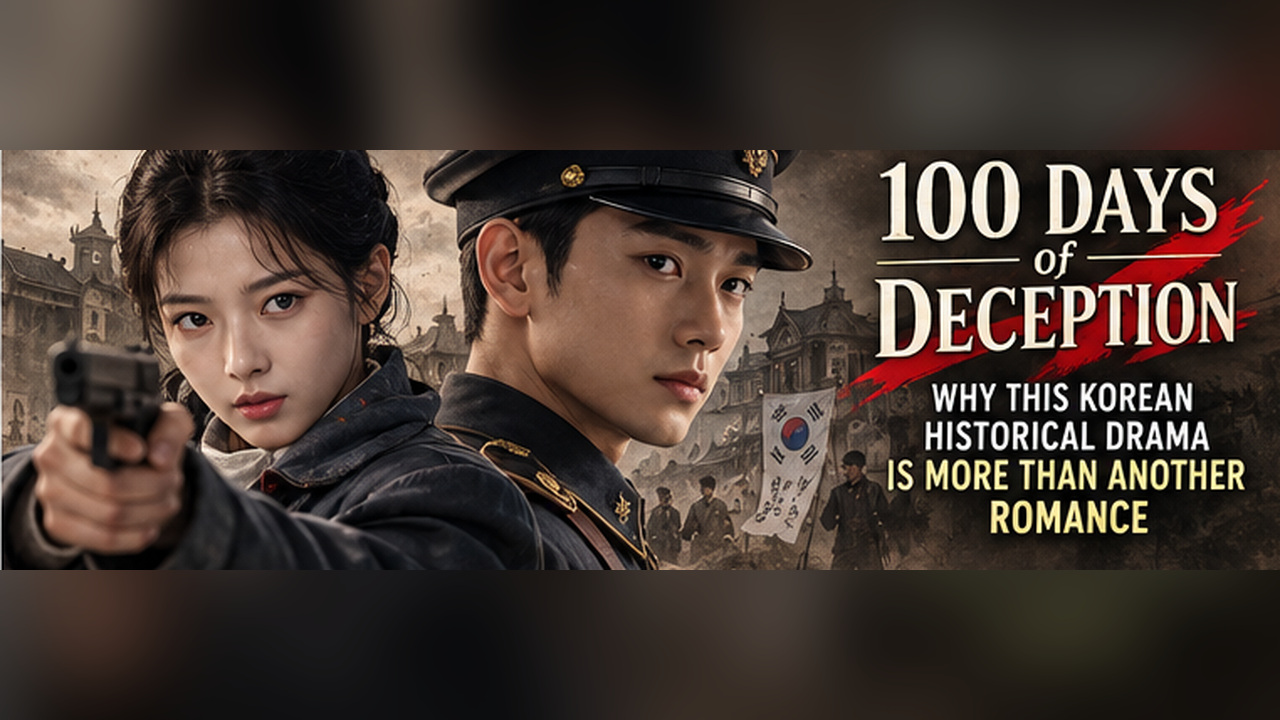
100 Days of Deception – why this Korean historical drama is more than another romance
Korean historical dramas have become a favourite among international audiences, particularly those who enjoy stories combining romance, political intrigue and emotionally complicated characters. Productions such as The Red Sleeve, Mr. Sunshine and Moon Embracing the Sun have demonstrated how historical settings can provide the foundation for memorable relationships and powerful dramatic conflicts.
However, not every historical K-drama is set within a royal palace. Some of the most interesting productions explore more recent periods of Korean history, particularly those shaped by political occupation, resistance movements and struggles for independence.
100 Days of Deception, which premiered on Netflix on 10 October 2026, takes audiences into that world. Starring Kim You-jung and Park Jin-young, the drama combines historical espionage, political danger and romance during the Japanese colonial period in Korea.
At the centre of the story is a young pickpocket whose involvement in the independence movement forces her to navigate dangerous relationships and conceal secrets that could place numerous lives at risk.
For viewers who enjoy historical dramas with substantial political conflict alongside their romantic storylines, the premise offers an intriguing alternative to the more familiar palace romance.
What is 100 Days of Deception about?
Set in Gyeongseong, the name used for Seoul during the Japanese colonial era, the drama follows Lee Ga-kyung, a resourceful young pickpocket portrayed by Kim You-jung.
Ga-kyung’s circumstances change dramatically when she becomes involved with an underground independence organisation known as Gugukdan. What begins as a personal struggle for survival develops into a dangerous world of espionage, deception and political resistance.
Her involvement requires her to gather information while maintaining appearances and concealing her true intentions from those around her.
Among the people she encounters is Sato Hideo, a Government-General interpreter played by Park Jin-young. His position places him close to the colonial administration, creating an environment in which personal relationships and political loyalties become increasingly difficult to separate.
The story also introduces So-ran, a sniper whose activities add another dimension to the wider conspiracy.
As the characters become entangled in conflicting missions and personal relationships, the drama explores the consequences of trust and betrayal in a setting where an apparently insignificant mistake could expose an entire resistance operation.
Why the historical setting matters
Korea experienced Japanese colonial rule from 1910 until 1945, a period that had profound political, cultural and social consequences.
Independence movements developed in response to colonial administration, with activists and organisations pursuing different approaches to resistance.
The era remains an important part of Korean historical memory and has frequently provided the background for films and television dramas exploring identity, freedom and national independence.
Unlike traditional palace dramas, where political conflicts often centre on royal succession and court rivalries, stories set during the occupation can follow ordinary citizens who become involved in extraordinary circumstances.
A student, journalist, interpreter or seemingly insignificant member of society may possess information that places them at the centre of dangerous political developments.
For 100 Days of Deception, the historical setting is therefore essential to the story rather than simply providing attractive costumes and locations.
The danger surrounding the characters emerges directly from the political environment in which they live.
Kim You-jung returns to historical drama
Kim You-jung is particularly familiar to audiences who enjoy Korean historical productions.
She appeared in Moon Embracing the Sun before taking on the leading role of Hong Ra-on in Love in the Moonlight, a romantic historical drama that helped establish her popularity as an adult performer.
Her career has since expanded across contemporary romance, fantasy and more emotionally demanding roles.
In 100 Days of Deception, she plays a character whose intelligence and ability to improvise become essential to her survival.
Ga-kyung begins as someone concerned with her immediate circumstances, but her involvement in the independence movement introduces responsibilities and dangers extending far beyond her personal life.
That development has the potential to create a compelling character journey, particularly if the drama explores how her motivations change as she becomes increasingly involved in the political conflict.
A heroine who must rely on deception, observation and quick thinking can also provide an interesting contrast to conventional historical protagonists whose influence comes from noble status or established political authority.
Park Jin-young takes on a morally complicated role
Park Jin-young, known for his work as a member of GOT7 as well as his acting career, portrays Sato Hideo.
As an interpreter working within the colonial administration, Hideo occupies a position that could potentially expose him to sensitive information and conflicting loyalties.
Interpreters play an important role in communication between people who speak different languages, but in a historical espionage drama, that responsibility can also place a character close to influential individuals and politically dangerous information.
The circumstances surrounding Hideo create opportunities for uncertainty about his motivations and the extent to which his professional responsibilities reflect his personal beliefs.
Park Jin-young has previously appeared in productions such as The Devil Judge and Yumi’s Cells, demonstrating his ability to portray characters dealing with complicated emotional and moral situations.
A historical thriller provides another opportunity to explore those qualities within a different dramatic environment.
How does it compare with Mr. Sunshine?
Viewers familiar with Mr. Sunshine may recognise similarities in the themes explored by 100 Days of Deception.
Although the two productions are set during different historical circumstances, both involve characters whose personal relationships unfold against a backdrop of political unrest and resistance.
Mr. Sunshine combined romance with questions about national identity, loyalty and sacrifice, creating a story in which individual choices were shaped by much larger historical forces.
That approach made its romantic relationships especially complicated. Characters could not simply follow their feelings without considering the consequences for their communities, families or political commitments.
100 Days of Deception has the opportunity to explore similar tensions through espionage and the uncertainty created by hidden identities.
When characters cannot reveal their true allegiances, even apparently ordinary conversations can become emotionally and politically dangerous.
Why espionage makes historical dramas so compelling
Espionage stories rely on secrecy, conflicting loyalties and the constant possibility of betrayal.
Characters may use false identities, conceal information or maintain relationships with people they cannot completely trust.
For audiences, this creates suspense because the meaning of a scene can change depending on what each character knows.
A friendly conversation might actually be an attempt to gather intelligence, while a romantic encounter could conceal dangerous political intentions.
When those elements are placed within a historical setting, the consequences become more serious.
A failed mission could place an entire organisation at risk, while a character’s decision to protect someone they love might conflict with their political responsibilities.
The combination of personal emotion and historical danger provides an effective foundation for a drama that wants to offer more than a straightforward romance.
Can K-dramas encourage audiences to learn about history?
One of the advantages of international streaming is that audiences can discover stories set within historical periods they may know very little about.
A viewer might begin watching a Korean drama because they recognise an actor or enjoy romantic thrillers, only to become interested in the historical events surrounding the fictional narrative.
Productions such as Mr. Sunshine have demonstrated how historical fiction can encourage international discussion about Korean history, cultural identity and resistance movements.
However, it is important to remember that historical dramas are fictional entertainment rather than documentaries.
Writers may introduce fictional characters, combine historical events or adjust timelines to create a more coherent narrative.
The value of these stories often lies in encouraging curiosity and providing an emotional introduction to a historical setting, rather than offering a completely factual account.
For viewers interested in Korean history, the drama can therefore become a starting point for further reading.
Is 100 Days of Deception worth watching?
The premise brings together several elements that have proved popular among international K-drama audiences: a resourceful heroine, a morally complicated male lead, hidden identities and a historical setting in which personal decisions carry serious consequences.
Early premiere coverage has highlighted the drama’s mixture of character relationships, espionage and political intrigue.
However, it is still too early to judge the complete series based on its opening episodes. The strength of a historical thriller depends on whether its central mystery, character development and political conflicts remain engaging as the story progresses.
For fans who enjoy emotionally complex historical romances, 100 Days of Deception offers an interesting opportunity to explore a different period of Korean history.
Its strongest potential lies in the relationship between personal survival and political responsibility, particularly through characters who must decide whom they can trust and what they are willing to sacrifice.
If the drama develops those themes convincingly, it could become an engaging addition to the growing collection of Korean historical thrillers available to international audiences.
Do you prefer Korean historical dramas set in royal palaces, or stories exploring espionage, resistance movements and more recent historical events?
Share this article
