
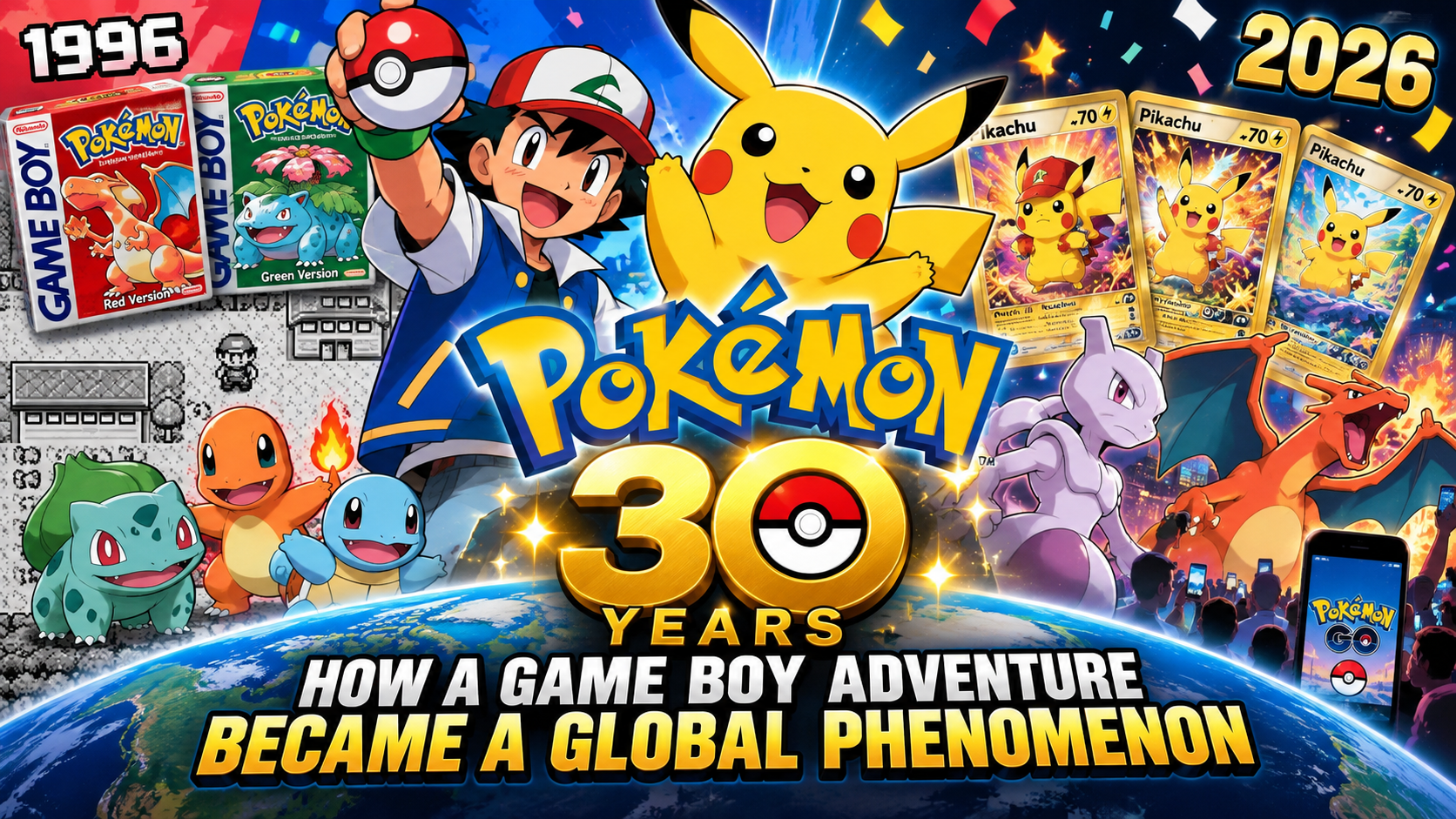
30 Years of Pokémon: How a Game Boy Adventure Became a Global Phenomenon
Thirty years ago, a small collection of fictional creatures began an adventure that would change the entertainment world forever. What started with two Japanese Game Boy games in 1996 would eventually become one of the most recognisable franchises in popular culture.
Pokémon has given us unforgettable characters, countless video game adventures, an enormously successful trading card game and an animated series that followed its original hero for more than 25 years. It has also created generations of fans who can still remember their first starter Pokémon, their favourite episode or the excitement of pulling a rare card from a booster pack.
In 2026, Pokémon celebrates its 30th anniversary, and the franchise is marking the milestone with special releases, trading cards and activities designed to bring fans together.
But perhaps the most remarkable thing about Pokémon is not how successful it became during the late 1990s.
It is that, three decades later, people are still collecting, battling, trading and discovering Pokémon.
So how did a game inspired by childhood insect collecting become a worldwide phenomenon? And why has Pokémon survived when so many other entertainment crazes have faded away?
It all started with a love of collecting creatures
The origins of Pokémon can be traced to Japanese game designer Satoshi Tajiri, whose childhood fascination with insects helped inspire the franchise.
Growing up, Tajiri enjoyed exploring the outdoors and collecting different species of insects. That sense of discovery, combined with his enthusiasm for video games, would eventually influence his ideas for an entirely new gaming experience.
Working with Game Freak and fellow designer Ken Sugimori, Tajiri helped develop the concept of a world inhabited by creatures that players could discover, capture, train and exchange.
The Nintendo Game Boy offered an important opportunity to bring the idea to life.
Its portability allowed players to take their adventures wherever they went, while the Game Boy Link Cable made it possible to connect two consoles and trade Pokémon.
This trading system became one of the most important features of the original games.
On 27 February 1996, Pocket Monsters Red and Green were released in Japan.
Players entered the fictional Kanto region, chose their first partner from Bulbasaur, Charmander or Squirtle and began a journey to challenge Gym Leaders, earn Badges and ultimately face the Pokémon League.
Along the way, they encountered the original 151 Pokémon, including the elusive Mythical Pokémon Mew.
Not every Pokémon could be obtained through ordinary gameplay in a single version. Certain Pokémon were exclusive to particular versions, encouraging players to trade with friends to complete their Pokédex. Mew, meanwhile, was not normally obtainable through standard gameplay and became famous for its special distribution events and surrounding rumours.
That combination of collecting, discovery and social interaction proved enormously appealing.
Pokémon offered an adventure that did not simply end when players defeated the strongest opponents. There were always more creatures to find, stronger teams to build and new strategies to explore.
And as players began sharing their discoveries, the Pokémon phenomenon started to grow.
The arrival of Pokémania


Pokémon’s transition from successful video game to cultural phenomenon happened remarkably quickly.
The Pokémon Trading Card Game debuted in Japan in October 1996, followed by the animated television series in April 1997.
The anime introduced viewers to Ash Ketchum, known as Satoshi in Japan, and his partner Pikachu.
Ash was an enthusiastic young Pokémon Trainer who dreamed of becoming a Pokémon Master. He was determined, occasionally overconfident and far from perfect, but his adventures gave viewers a character they could follow as he learned, competed and made friends.
Alongside Misty and Brock, Ash explored the Pokémon world while encountering familiar creatures from the games.
The series also introduced one of animation’s most recognisable villainous teams.
Jessie, James and Meowth of Team Rocket became fan favourites thanks to their elaborate schemes, disastrous attempts to capture Pikachu and unforgettable motto.
For many international fans, the anime became their introduction to Pokémon.
By the time the franchise expanded into North America in 1998 and other international markets, Pokémon had become much more than a video game.
Children were watching the animated series, playing the games, collecting cards and buying merchandise featuring their favourite creatures.
Pokémon appeared on school bags, lunchboxes, clothing, toys and stationery. Trading cards became playground treasures, while the games encouraged friendly competition and endless discussions about the strongest Pokémon.
The franchise also found success in cinemas.
The first animated Pokémon feature, Pocket Monsters the Movie: Mewtwo Strikes Back, premiered in Japan in 1998. It was subsequently released internationally as Pokémon: The First Movie, introducing audiences to the powerful genetically engineered Pokémon Mewtwo.
By the end of the decade, Pokémania had become one of the defining entertainment crazes of the era.
Pokémon was no longer simply something children played or watched.
It had become something they experienced together.
The trading cards that became childhood treasures


Ask someone who grew up during the original Pokémon craze what they remember most, and there is a good chance trading cards will feature somewhere in the conversation.
For many children, opening a Pokémon booster pack was an event.
There was the anticipation of discovering which cards were inside, the disappointment of pulling yet another duplicate and the excitement of finally finding a favourite Pokémon.
The original cards became valuable social currency in playgrounds.
Friends compared collections, negotiated trades and carefully organised their cards into albums. Some collected simply because they loved the artwork and characters, while others learned the rules of the trading card game and competed against friends.
Among the most memorable cards was Charizard.
The holographic Charizard card from the original English-language Base Set became one of the most sought-after cards of its era, helped by the Pokémon’s popularity and its imposing appearance.
For some children, owning a Charizard card represented the ultimate collecting achievement.
Decades later, early Pokémon cards have become an established part of the collectibles market.
Rare examples in exceptional condition, particularly certain first-edition cards, can command substantial prices. However, the value of any individual card depends on factors such as its edition, rarity, authenticity, condition and collector demand.
Most childhood collections are not hidden fortunes, despite what sensational headlines might suggest.
Nevertheless, Pokémon cards have achieved something unusual.
They have remained relevant to younger collectors while attracting adults who remember the original craze.
For some fans, collecting is about completing a set or finding particularly beautiful artwork. For others, it is about nostalgia, competition or the excitement of opening a new booster pack.
The cards have become more than a promotional addition to the video games.
They are an important part of Pokémon’s identity.
How Pokémon survived the end of the 1990s
The late 1990s produced plenty of popular toys, television programmes and entertainment crazes.
Many enjoyed enormous success before gradually disappearing from mainstream attention.
Pokémon could easily have followed that pattern.
Instead, the franchise continued introducing new adventures while preserving the elements that made the original games successful.
Pokémon Gold and Silver expanded the experience with the Johto region and introduced a second generation of Pokémon. Later titles, including Ruby and Sapphire, Diamond and Pearl, Black and White, X and Y, Sun and Moon, Sword and Shield and Scarlet and Violet, brought new regions, Pokémon and gameplay features.
Each generation offered something different, but the familiar foundations remained.
Players continued exploring, catching Pokémon, developing their teams and challenging opponents.
The games also evolved alongside Nintendo’s hardware, progressing from the original Game Boy to more advanced handheld systems and home console experiences.
Meanwhile, the animated series followed Ash and Pikachu into new regions, introducing different companions, rivals and Pokémon.
The trading card game continued releasing expansions and developing its competitive community.
This constant evolution helped Pokémon avoid becoming a franchise associated exclusively with one generation.
Children who discovered Pokémon in the 1990s could return to it years later, while younger audiences encountered entirely new games, characters and stories.
Perhaps most importantly, Pokémon developed several different ways for fans to participate in its world.
Someone who no longer played the video games could still enjoy collecting cards. A fan who stopped watching the anime could continue following new releases. Others remained interested in particular Pokémon, merchandise or competitive battling.
Pokémon no longer depended on a single product to maintain its popularity.
It had become an entire entertainment universe.
Pokémon GO brought Pokémania into the real world


In July 2016, Pokémon experienced another extraordinary surge in popularity.
The release of Pokémon GO, developed by Niantic in collaboration with The Pokémon Company and Nintendo, introduced a new way to experience the franchise.
Rather than exploring a fictional region through a traditional gaming console, players used their smartphones to discover Pokémon in real-world locations.
Parks, shopping centres, neighbourhood streets and public landmarks became part of the adventure.
People gathered outdoors to search for rare Pokémon, visit PokéStops and compete at Gyms.
The game’s popularity attracted enormous attention, particularly because it brought together people who might not otherwise have interacted.
Longtime fans who had grown up playing the original games were suddenly catching Pokémon again, this time through their phones.
For some, Pokémon GO felt like a childhood fantasy becoming reality.
The creatures they once searched for on a small Game Boy screen could now appear through an augmented reality experience.
The game also introduced Pokémon to people who had little previous experience with the franchise.
Its success illustrated how effectively Pokémon’s original concept could adapt to changing technology.
Twenty years after its debut, Pokémon had once again become a major cultural talking point.
The experience was different, but the central idea remained familiar.
Explore. Discover. Collect. Share.
The emotional farewell to Ash Ketchum
For more than 25 years, Ash Ketchum and Pikachu remained central to Pokémon’s animated adventures.
Generations of viewers watched Ash travel through different regions, challenge powerful opponents, form friendships and pursue his dream of becoming a Pokémon Master.
His journey was filled with victories and disappointments.
One major milestone came in 2019, when Ash became the first Champion of the Alola Pokémon League.
Then, in November 2022, he achieved an even greater competitive victory by defeating Leon in the final of the Masters Eight Tournament at the World Coronation Series, earning the title of World Champion.
For fans who had followed his adventures since the original series, it was a long-awaited achievement.
In 2023, Ash’s journey as the anime’s central protagonist came to an end.
The final Japanese episode of Pokémon: To Be a Pokémon Master, which concluded Ash and Pikachu’s main television story, aired on 24 March 2023.
The farewell was particularly emotional for viewers who had grown up with the characters.
However, Ash’s departure did not mean the end of the Pokémon anime.
Pokémon Horizons: The Series introduced new protagonists, Liko and Roy, along with new stories and adventures.
Pikachu also remained part of the animated world, with Captain Pikachu serving as a notable character in the newer series.
The transition marked the end of an era, but it also showed that Pokémon could continue evolving beyond its original television hero.
Pokémon celebrates 30 years in 2026


On 27 February 2026, Pokémon officially reached its 30th anniversary, three decades after Pocket Monsters Red and Green launched in Japan.
The anniversary has become a celebration of Pokémon’s history, characters and fans, with activities and product releases taking place throughout the year.
The Pokémon Company began its anniversary campaign with a Super Bowl advertisement built around a familiar question: Who is your favourite Pokémon?
It was an appropriate theme for a franchise whose enormous collection of creatures has helped create personal connections with fans around the world.

One of the most significant anniversary releases has been the Pokémon Trading Card Game’s special 30th Celebration expansion, which launched simultaneously worldwide on 16 September 2026.
The expansion includes more than 150 cards and draws inspiration from different periods of Pokémon history.
Among its features are 30 Pikachu rare cards, each with a unique illustration. Every 30th Celebration booster pack contains one of these Pikachu cards, alongside additional foil cards and a foil Basic Energy card.
The expansion also includes a Classic Collection featuring 30 iconic cards from the trading card game’s history, as well as new illustration rares and special illustration rares.
Popular Pokémon such as Mew, Mewtwo, Umbreon and Greninja feature in the anniversary release, bringing together characters from different generations.
The celebration extends beyond the cards themselves.
Special products released in September included Elite Trainer Boxes, poster collections and Pokémon ex boxes, while October has brought further releases such as booster bundles and collectible mini tins.
The October product range also includes 30th Celebration Battle Decks featuring Espeon ex and Umbreon ex.
Additional products are scheduled for the remainder of 2026, although local availability and retail release timing may differ between countries.
For collectors, the anniversary offers an opportunity to celebrate Pokémon’s past while discovering new artwork and products.
For longtime fans, it is another reminder of how far the franchise has travelled since its humble Game Boy beginnings.
And for a new generation, the anniversary may become their own introduction to Pokémon.
Why are adults still collecting Pokémon?
There is something particularly interesting about Pokémon’s appeal to adults.
Many of the children who experienced Pokémania during the late 1990s are now in their thirties and forties.
Yet their enthusiasm for Pokémon has not necessarily disappeared.
Some have returned to the video games. Others collect trading cards, build displays of their favourite characters or revisit the original animated series.
Nostalgia undoubtedly plays a role.
Pokémon can bring back memories of childhood friendships, trading cards during school breaks, watching television after school or spending hours attempting to complete a Pokédex.
A particular Pokémon might remind someone of the first game they owned, while a familiar piece of music can instantly recall an adventure they experienced decades ago.
But nostalgia does not explain everything.
Pokémon has also remained accessible to new audiences, which means longtime fans are not simply revisiting something that belongs to the past.
They can continue discovering new games, new Pokémon and new experiences.
The trading card game is a particularly good example.
Modern Pokémon cards feature elaborate artwork, different rarities and special finishes that appeal to collectors interested in both the characters and the visual designs.
Others participate in organised card competitions, enjoy collecting complete expansions or concentrate on cards featuring particular Pokémon.
The franchise allows fans to engage at different levels.
You do not need to own every game, watch every episode or collect every card to enjoy Pokémon.
Sometimes, having one favourite Pokémon is enough.
The original 151 still hold a special place


Despite the introduction of hundreds of additional Pokémon over the decades, the original 151 remain particularly significant in the franchise’s history.
For longtime fans, creatures such as Pikachu, Charizard, Eevee, Gengar, Mewtwo and the three original starter Pokémon are closely associated with Pokémon’s earliest years.
They were the creatures that helped establish the franchise’s identity.
The original starters also represent one of gaming’s most memorable decisions.
Would you choose Bulbasaur, Charmander or Squirtle?
Each offered a different beginning to the same adventure, and the choice became something players could discuss and debate with friends.
Pokémon has maintained that tradition of personal attachment through subsequent generations.
Every player has favourites, and those favourites are not always determined by which Pokémon is the strongest or rarest.
Some fans choose Pokémon because of their appearance, personality or role in the anime. Others develop attachments through memorable experiences in the games.
That personal connection is one of the franchise’s enduring strengths.
For every person who considers Charizard the ultimate Pokémon, another will insist that their favourite is something completely different.
And with so many creatures to choose from, there is plenty of room for disagreement.
The secret behind Pokémon’s remarkable success
It would be tempting to attribute Pokémon’s success entirely to clever marketing, strong merchandise sales and memorable character designs.
Those factors have certainly contributed to its longevity.
But Pokémon’s appeal also comes from the unusually flexible concept at its centre.
The original games combined exploration, collecting, strategy and social interaction in a way that encouraged players to invest time in their own adventures.
Unlike a story that unfolds in exactly the same way for everyone, Pokémon allowed players to form their own teams, select their favourites and create personal experiences.
Two people could play the same game and come away with different stories.
The trading card game expanded that experience by encouraging collecting, trading and competition.
The anime gave individual Pokémon personalities and emotional relationships that extended beyond their roles in the games.
Later releases, particularly Pokémon GO, found entirely new ways to interpret the same basic idea.
Through all these changes, Pokémon has retained something recognisable.
There is still excitement in encountering an unfamiliar creature, discovering a rare card or winning a difficult battle.
There is still satisfaction in developing a team and sharing achievements with other fans.
And perhaps most importantly, there is still a sense that another adventure is waiting.
Thirty years later, the adventure continues
When Pocket Monsters Red and Green arrived in Japan on 27 February 1996, few could have imagined that the games would inspire three decades of entertainment.
What began as an unusual collecting adventure on the Game Boy became a franchise spanning video games, television, films, trading cards, merchandise and worldwide fan communities.
Pokémon has experienced extraordinary commercial success, introduced generations of memorable characters and survived major changes in technology and entertainment habits.
It has also become something more personal for many of its fans.
For one generation, Pokémon represents childhood memories of the original games and anime.
For another, it means discovering new regions, building competitive teams or collecting modern trading cards.
For others, Pokémon began with Pokémon GO, a favourite animated series or a single card received as a gift.
The 30th anniversary celebrations offer an opportunity to look back at everything the franchise has achieved, but they also demonstrate why Pokémon remains relevant today.
The world of Pokémon continues to expand, and new fans are still discovering the excitement that captivated players back in 1996.
Thirty years, countless adventures and generations of fans later, Pokémon has proven that some childhood favourites never really disappear.
They simply evolve.
What is your favourite Pokémon memory? Did you grow up playing the original games, watching Ash and Pikachu or collecting trading cards? And which Pokémon would you choose as your ultimate favourite?
Share this article
