
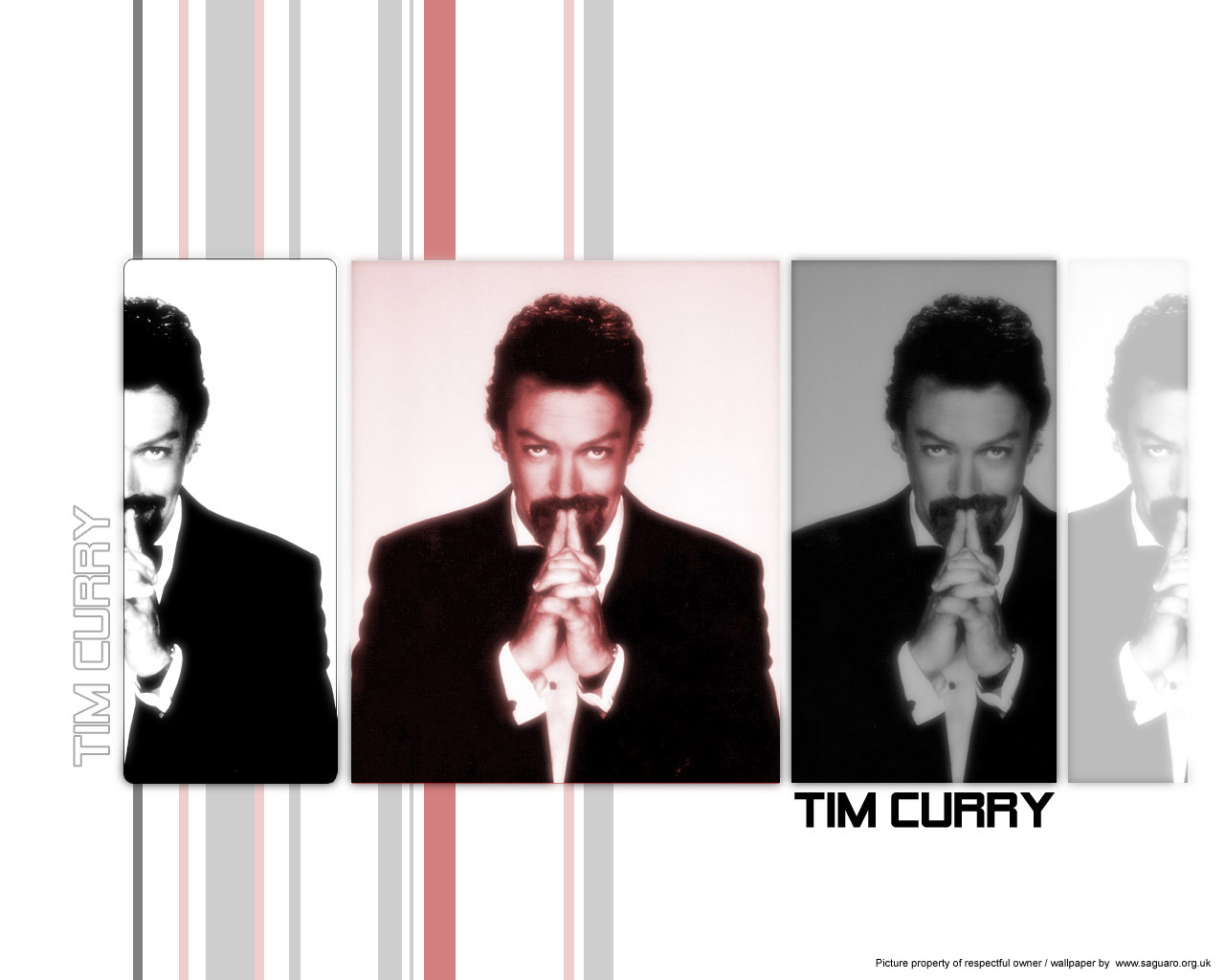
Tim Curry: Far More Than Frank-N-Furter – A Career Built on Villains, Pirates, Wizards, Kings and Pure Theatrical Chaos
There are actors who become famous for one role. Then there are actors like Tim Curry, who somehow manage to create half a dozen characters that could each have defined an entire career.
For one generation, he will forever be Dr. Frank-N-Furter, descending in fishnets and announcing himself to an unsuspecting Brad and Janet. For another, he is Pennywise staring out from beneath the streets of Derry. Children of the 1990s may hear his name and immediately think of Nigel Thornberry. Muppet fans know him as Long John Silver. Fantasy devotees remember Darkness in Legend. Comedy fans can quote Wadsworth from Clue. Gamers have encountered him as Gabriel Knight, Arl Rendon Howe and even Satan.
And that barely scratches the surface.
Looking through Curry’s astonishing career history, what becomes clear is that Tim Curry was never simply a film actor who occasionally did other work. He was a genuine all-round performer whose career stretched across theatre, film, television, animation, family entertainment and video games. He played Shakespeare and Sondheim-sized theatrical roles. He played monsters, monarchs, murderers, magicians, pirates, demons, detectives, clergymen, villains and talking animals.
Sometimes all that seemed to be missing was Tim Curry playing Tim Curry.
So, rather than remembering him through only the handful of performances that became pop-culture landmarks, it is worth looking at just how extraordinary the complete career really was.
Before Rocky Horror: Tim Curry was a theatre actor first
Long before Transylvania entered the picture, Curry was building his career on stage.
His professional theatrical work stretches back to 1968–1969, when he appeared in Hair as Woof and a tribe member. From there came an extraordinary concentration of stage work: After Haggerty, The Exploding Dream, The Sport of My Mad Mother, Lie Down I Think I Love You and Cinderella.
And then came the classics.
During the early 1970s Curry appeared as Bassianus in Titus Andronicus, Camillo in The White Devil, Lacroix in Danton’s Death, Sagredo in Life of Galileo, Sexton in Man Is Man and Solange in The Maids. In 1972 he played Puck in A Midsummer Night’s Dream.
That early career matters because it explains something about virtually everything Curry did afterwards. Even when he was playing the most ridiculous villain imaginable, there was always something theatrical about him. His voice, movement, timing and ability to make an entrance did not arrive in Hollywood. They had been forged on stage.
And then, in 1973, came the role that changed everything.
Frank-N-Furter changes pop culture
Curry originated Dr. Frank-N-Furter in The Rocky Horror Show on stage, performing the role from 1973 to 1975.
Two years after the stage production began, Curry brought Frank to the screen in 1975’s The Rocky Horror Picture Show.
It is difficult now to explain just how unusual the performance remains.
Frank-N-Furter is funny, threatening, seductive, absurd, flamboyant, cruel and strangely vulnerable – often within the same scene. Curry does not cautiously play the character. He completely commits to him.
That commitment is a recurring feature throughout his career. Curry understood that the quickest way to ruin an outrageous character was to act as though you were embarrassed by him. He rarely seemed embarrassed by anything.
The Rocky Horror Picture Show became one of the defining cult films in cinema history and Frank-N-Furter became Curry’s most recognisable creation.
For many actors, that would have been the peak.
For Curry, it was basically the beginning.
The stage career continued – and it was enormous
One of the most interesting things about Curry’s career is how consistently he returned to theatre.
Immediately after Rocky Horror, he appeared in Travesties as Tristan Tzara from 1975 to 1976. In 1980–1981 he took on Wolfgang Amadeus Mozart in Amadeus.
Then came another role ideally suited to Curry’s larger-than-life abilities: the Pirate King in The Pirates of Penzance in 1982.
During the 1980s his theatre credits continued through productions including The Rivals, Love for Love and Dalliance. In 1986 he played Macheath – Mack the Knife – in The Threepenny Opera.
From 1987 to 1988 he starred as Bill Snibson in Me and My Girl, followed by William Hogarth in The Art of Success and Alan Swann in My Favorite Year.
Even after his screen career had become firmly established, Curry continued taking major theatrical parts. He played Ebenezer Scrooge in A Christmas Carol in 2001 and then one of his great later-stage roles: King Arthur in Spamalot from 2004 to 2007.
In 2011 he appeared as The Player in Rosencrantz and Guildenstern Are Dead and in 2012 as Reverend Whoopsie in What About Dick?
From Shakespeare to Rocky Horror, Mozart to Monty Python, that alone would constitute an impressive career.
But Curry was simultaneously building an equally strange filmography.
From Darkness to Wadsworth: the films
Curry’s film career may be one of the most wonderfully unpredictable CVs in Hollywood.
After Rocky Horror, he appeared as Robert Graves in 1978’s The Shout and Johnny LaGuardia in Times Square in 1980.
Then in 1982 he became Rooster Hannigan in Annie.
Even here the classic Tim Curry ingredients are evident. Give him a character with dubious morals, theatrical dialogue and an opportunity to sneer and he could turn a supporting role into something audiences remembered decades later.
But the mid-1980s produced two performances that helped cement his reputation as one of cinema’s great cult actors.
Darkness – Legend
In 1985, Curry became Darkness in Legend.
It remains one of the most physically spectacular characters of his career: enormous horns, red skin, hooves and enough demonic grandeur to make most fantasy villains seem underdressed.
But the make-up works because Curry performs through it. Darkness is not simply a creature effect. Curry gives him elegance, intelligence and that unmistakable voice.
It is one of the great examples of something Curry did repeatedly throughout his career: making villains enjoyable without making them harmless.
Wadsworth – Clue
And in the same year came something completely different.
Wadsworth in Clue.
Curry’s performance is one of the engines driving the entire movie. He shifts between controlled butler, nervous participant, suspicious observer and increasingly frantic storyteller before the film’s famously manic final stretch.
The physical comedy alone is remarkable.
Watching Curry race through rooms while simultaneously explaining a murder plot has become one of the great joys of 1980s comedy.
Clue initially struggled to become the phenomenon it later became, but its reputation has grown enormously. Today, Wadsworth sits comfortably alongside Frank-N-Furter, Pennywise, Darkness and Long John Silver among Curry’s most beloved performances.
The 1990s: Curry becomes the king of unforgettable supporting characters
Curry entered the 1990s with a small role as Dr. Petrov in The Hunt for Red October.
Then the Tim Curry supporting-role machine really got going.
He played Dr. Thornton Poole in Oscar, Mr. Hector, the concierge in Home Alone 2: Lost in New York, Boyd Pinter in Passed Away, Cardinal Richelieu in The Three Musketeers and Jigsaw in Loaded Weapon 1.
His Mr. Hector deserves special mention.
There are not many performers who could turn suspiciously examining a credit card into a memorable comic performance.
Curry could.
He followed that run with Farley Claymore in The Shadow, Herkermer Homolka in Congo and Cupid’s Caseworker in Lover’s Knot.
And then came a pirate.
Long John Silver – perhaps the most Tim Curry pirate imaginable
In 1996’s Muppet Treasure Island, Curry played Long John Silver.
The casting is almost absurdly perfect.
Curry understood exactly what kind of movie he was in. He never condescends to the Muppets and never treats the production as though he is the serious human actor surrounded by puppets.
He performs with them.
Long John Silver becomes charming, dangerous, funny and genuinely affectionate towards Jim Hawkins. Curry gets songs, swordplay, villainy and enormous speeches – essentially every ingredient he needed to have a very good time.
There is a reason Muppet Treasure Island continues to be rediscovered.
And there is an equally good reason Curry remains one of the most beloved human performers ever to share the screen with the Muppets.
Gomez Addams, Professor Oldman and more
The late 1990s and early 2000s continued at full speed.
Curry played Maj. Vladikov in McHale’s Navy, Gomez Addams in Addams Family Reunion and Jezebel Jack in Pirates of the Plain.
In 2000 he appeared in Charlie’s Angels as Roger Corwin, as well as Sorted and Four Dogs Playing Poker.
Then came Professor Oldman in Scary Movie 2 in 2001 – another magnificently strange entry in an already strange career.
Other film roles followed in Ritual, The Scoundrel’s Wife, Kinsey, Bailey’s Billions, Christmas in Wonderland, The Secret of Moonacre and finally Burke and Hare in 2010 as Dr. Monroe.
But Curry’s live-action film career is only half of the screen story.
Because television gave him one of the most terrifying characters of his life.
Pennywise
In 1990, Tim Curry became Pennywise in It.
No computer-generated contortions. No elaborate digital monster transformations.
Mostly just Tim Curry wearing clown make-up and smiling.
And somehow that was enough.
Curry’s Pennywise works because the character can switch instantly between ridiculous and horrifying. One moment he sounds like a children’s entertainer. The next there is something unmistakably predatory underneath.
The performance became so iconic that for an entire generation, Pennywise essentially was Tim Curry.
And yet even this was only one television role among dozens.
Tim Curry was everywhere on television
His television career began back in the late 1960s and stretched across almost five decades.
During the 1970s and 1980s he appeared in productions including Ace of Wands, The Duchess of Malfi, Play for Today, Napoleon and Love, Three Men in a Boat, Rock Follies of ’77, Life of Shakespeare, Oliver Twist, Blue Money, The Worst Witch, Wiseguy and The Tracey Ullman Show.
After It, television appearances continued through titles such as Tales from the Crypt, Roseanne, Earth 2, The Naked Truth, Titanic, Lexx and Jackie’s Back!.
The 2000s brought another remarkable series of appearances: Family Affair, Will & Grace, Monk, Psych, The Colour of Magic, Cranford, Alice, Agatha Christie’s Poirot and Criminal Minds.
In 2016 he returned to the world that made him famous with The Rocky Horror Picture Show: Let’s Do the Time Warp Again, this time appearing as the Criminologist rather than Frank.
There is something rather wonderful about that symmetry.
But by this point another Tim Curry career had already been happening alongside everything else.
And it may be the part casual fans underestimate most.
Tim Curry’s enormous voice-acting career
If you grew up watching animation from the late 1980s through the 2000s, there is a very good chance that Tim Curry appeared somewhere in your childhood without you realising it.
His voice credits are staggering.
Curry possessed one of those rare voices that could immediately communicate intelligence, menace, arrogance or lunacy. Animation producers understandably realised that this made him extremely useful whenever they needed an unforgettable villain.
And so Tim Curry seemingly became everybody.
Captain Hook, villains and Saturday-morning television
Among his early television voice work were The Greatest Adventure: Stories from the Bible, Fantastic Max, Long Ago and Far Away and Paddington Bear.
Then came Captain Hook in Fox’s Peter Pan & the Pirates from 1990 to 1991.
During the early 1990s Curry’s voice began appearing throughout animation: Tiny Toon Adventures, TaleSpin, The Pirates of Dark Water, The Legend of Prince Valiant, Captain Planet and the Planeteers, Darkwing Duck, Tom & Jerry Kids, Fish Police, Dinosaurs and even Batman: The Animated Series.
And he kept going.
The Little Mermaid.
Eek! The Cat.
Mighty Max.
Sonic the Hedgehog.
Aladdin.
The Mask: Animated Series.
Gargoyles.
Mighty Ducks.
Jumanji.
Freakazoid!.
The list starts becoming slightly ridiculous.
And then we reach one of Curry’s most beloved voice performances.
Nigel Thornberry
From 1998 to 2004, Curry voiced Nigel Thornberry in The Wild Thornberrys.
Nigel is one of those characters where the voice is the character.
Remove Curry’s bizarrely enthusiastic delivery and Nigel simply would not be Nigel.
The performance became so recognisable that years later Nigel Thornberry enjoyed an unexpected second life as an internet meme, introducing a completely new generation to Curry’s work.
Curry returned to Nigel for The Wild Thornberrys Movie in 2002 and Rugrats Go Wild in 2003. In the movie he also voiced Radcliff Thornberry.
But even Nigel represents only one corner of Curry’s animation career.
From Gargoyles to Star Wars
The later voice credits include The Net, Voltron: The Third Dimension, Hey Arnold!, Recess, Teacher’s Pet, Samurai Jack, Ozzy & Drix, The Adventures of Jimmy Neutron, The Proud Family, Duck Dodgers, Loonatics Unleashed, Phineas and Ferb, Ben 10: Alien Force and Regular Show.
He played G. Gordon Godfrey in Young Justice.
He became Doctor Morocco in Transformers: Rescue Bots.
He appeared in Star Wars: The Clone Wars as Chancellor Palpatine/Darth Sidious.
Then there were Wonder Pets!, Ben 10: Omniverse and finally Auntie Whispers in Over the Garden Wall in 2014.
Think about that range for a moment.
The same actor who played Frank-N-Furter, Pennywise and Darkness also voiced Nigel Thornberry, Captain Hook, Darth Sidious and Auntie Whispers.
There are not many CVs like that.
The animated movies deserve their own chapter
Curry’s feature-animation work is equally extensive.
In 1992’s FernGully: The Last Rainforest he voiced Hexxus, turning pollution itself into one of the most charismatic animated villains of the decade.
He followed it with Drake in The Pebble and the Penguin and Forte in Beauty and the Beast: The Enchanted Christmas.
Then came Ebenezer Scrooge in an animated A Christmas Carol, Rex Pester in The Rugrats Movie, Nero in The Easter Story Keepers, Ben Ravencroft in Scooby-Doo! and the Witch’s Ghost and The Skull in Bartok the Magnificent.
Through the 2000s he continued appearing in an enormous number of animated features: Lion of Oz, Rugrats in Paris, Barbie in the Nutcracker, The Cat Returns, The Wild Thornberrys Movie, Valiant, Garfield: A Tail of Two Kitties, A Sesame Street Christmas Carol, Fly Me to the Moon, Scooby-Doo! and the Goblin King, Barbie and the Three Musketeers and Curious George 2.
Later voice-film credits include A Turtle’s Tale: Sammy’s Adventures, The Outback, Back to the Sea, Strange Frame, Saving Santa, Ribbit and more.
Remarkably, the career record even extends to 2024’s Stream, with Curry credited as Lockwood.
More than half a century after his earliest professional work, the credits were still coming.
And then there were the video games
Because apparently stage, film, television and animation were not enough.
Curry also built an impressive video-game career.
He voiced Gabriel Knight in Gabriel Knight: Sins of the Fathers in 1993 and returned for Gabriel Knight 3 in 1999.
Other game roles included Melek in Wing Commander III: Heart of the Tiger, Count Nefarious in Toonstruck, King Chicken in Duckman: The Graphic Adventures of a Private Dick and Stratos in Sacrifice.
He then voiced Satan in The Four Horsemen of the Apocalypse and the Mastermind in Scooby-Doo! Night of 100 Frights.
His Professor Finbarr Calamitous appeared throughout the Jimmy Neutron and Nicktoons games.
And the final stretch contains two particularly memorable performances: Emperor Doviculus in Brütal Legend and Arl Rendon Howe in Dragon Age: Origins, both released in 2009.
Once again Curry was doing what he did best: finding villains with enormous personalities and making them even bigger.
The secret of a great Tim Curry villain
It is tempting to describe Curry simply as a great villain actor.
But that does not quite explain him.
Curry understood something important about villains: they usually believe they are the most interesting person in the room.
Darkness does.
Pennywise certainly does.
Cardinal Richelieu does.
Long John Silver does.
Hexxus absolutely does.
And Frank-N-Furter practically built a castle around the concept.
Curry gave these characters confidence. He gave them voices you wanted to imitate. He made them theatrical without turning them into meaningless caricatures.
Even when he went completely over the top, there was precision underneath it.
That is why his characters survived.
A performer who never stayed in one box
What makes Tim Curry’s career genuinely extraordinary is not simply its length.
It is the range of worlds he occupied.
He could perform Shakespeare and musical theatre.
He could terrify an entire generation as a clown.
He could anchor a cult murder comedy.
He could stand opposite Kermit the Frog and make Long John Silver feel completely real.
He could disappear behind enormous prosthetics as Darkness.
He could turn Nigel Thornberry into one of animation’s most instantly recognisable voices.
He could play Mozart, King Arthur, Scrooge, Macheath, the Pirate King and Puck on stage.
He could voice Satan in a video game, Darth Sidious in Star Wars and then appear in Phineas and Ferb.
That is not a conventional career.
It is a wonderfully Tim Curry career.
More than Rocky Horror
There is no escaping Frank-N-Furter.
Nor should there be.
The Rocky Horror Picture Show is one of those rare films that escaped the normal life cycle of cinema and became something closer to a ritual. Curry’s performance is central to why it survived.
But reducing Tim Curry to Rocky Horror is like reducing Christopher Lee to Dracula.
It ignores the extraordinary career that happened around it.
Curry spent decades moving between prestigious theatre, cult cinema, mainstream Hollywood, television drama, comedy, children’s entertainment, animation and gaming. Sometimes he was the star. Sometimes he appeared for only a few minutes.
Yet Curry had an unusual ability to make those minutes count.
Fans remember the concierge from Home Alone 2.
They remember Wadsworth running through the mansion.
They remember Darkness stepping from the shadows.
They remember Long John Silver.
They remember Pennywise.
They remember Hexxus.
They remember Nigel Thornberry.
And, of course, they remember Frank.
The wonderful problem with choosing Tim Curry’s greatest role
Ask ten Tim Curry fans for their favourite performance and you may receive ten completely different answers.
One will immediately say Frank-N-Furter.
Another will insist it is Wadsworth.
Someone else will choose Pennywise.
Fantasy fans might say Darkness.
Muppet fans will defend Long John Silver to the death.
A generation raised on Nickelodeon may simply shout Nigel Thornberry.
And perhaps that is the best tribute to Curry’s career.
There is no single Tim Curry.
There are dozens of them.
The theatrical rebel. The horror icon. The fantasy monster. The comic butler. The pirate. The clown. The king. The wizard. The voice from our childhoods.
Across more than five decades of work, Tim Curry created a collection of characters so strange, varied and memorable that almost everyone seems to have their own Tim Curry.
And very few performers can claim something quite as wonderful as that.
Share this article
