
The strange history behind Halloween
Pumpkins are so closely linked with Halloween that it is difficult to imagine the holiday without them.
Every October, they appear on doorsteps, in shop windows and across social media, carved into grinning jack-o’-lanterns and glowing through the darkness.
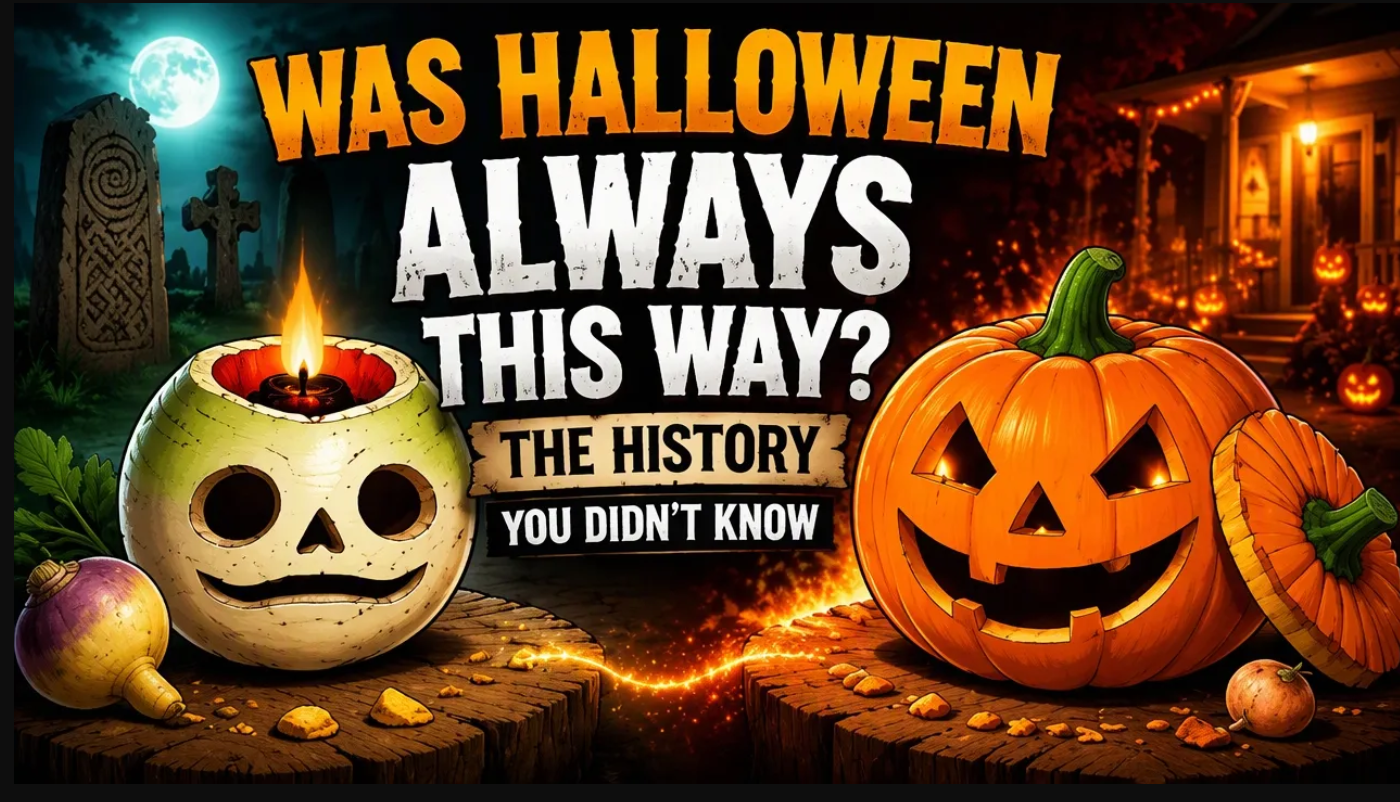
But pumpkins were not the original Halloween lantern.
Before the pumpkin took over, people were carving something considerably smaller, harder and arguably far more unsettling.
Turnips.
And that is only one of the strange stories hiding behind Halloween.
From Celtic festivals and wandering spirits to Harry Houdini and record-breaking pumpkins, the history of Halloween is far more interesting than many of the popular “Halloween facts” repeated online suggest.
Before pumpkins, there were turnips
The modern jack-o’-lantern has roots in traditions from Ireland, Scotland and other parts of the British Isles.
People carved faces into turnips, swedes and other root vegetables before placing lights inside them.
These carved lanterns eventually became associated with Halloween and with frightening away spirits.
They were also connected to the Irish folktale of Stingy Jack.
According to variations of the legend, Jack repeatedly tricked the Devil and was eventually refused entry into both Heaven and Hell. Condemned to wander the Earth, he was supposedly given a burning coal to light his way.
Jack placed the coal inside a hollowed-out turnip.
The strange figure became known as Jack of the Lantern, eventually shortened to jack-o’-lantern.
And if you have ever seen photographs of traditional carved turnips, you will know that they can look considerably more disturbing than the cheerful orange pumpkins we carve today.
So how did pumpkins take over?
The change largely happened after Irish and Scottish immigrants brought their Halloween traditions to North America during the nineteenth century.
Pumpkins were widely available there.
More importantly, they were much easier to carve.
Anyone who has tried cutting into a turnip can probably understand why the switch happened fairly quickly.
Pumpkins were larger, softer and provided far more space for elaborate faces and designs.
Over time, the glowing pumpkin jack-o’-lantern became one of the defining images of Halloween.
The turnip had officially lost the battle.
Halloween has become enormous business
Halloween may have ancient roots, but the modern celebration has become a major commercial event.
Costumes, sweets, decorations, parties and seasonal merchandise generate billions in spending every year, particularly in the United States.
One popular claim describes Halloween as the “second biggest commercial holiday after Christmas”.
That statement is repeated frequently, but it is difficult to support because there is no universally accepted way of ranking commercial holidays.
What we can say with confidence is that Halloween spending is enormous.
In the United States alone, Halloween spending was projected to reach approximately 13.5 billion dollars in 2026.
That is quite a transformation for a celebration whose traditions once involved turnips, bonfires and fears about wandering spirits.
Yes, there is a word for being afraid of Halloween
An extreme fear of Halloween is sometimes called samhainophobia.
The name comes from Samhain, the ancient Celtic festival frequently connected with the historical development of Halloween.
Samhain marked the end of the harvest season and the beginning of winter.
It was also traditionally associated with a time when the boundary between the worlds of the living and the dead was believed to become unusually thin.
That connection with spirits, darkness and the supernatural helped influence many traditions later associated with Halloween.
The biggest pumpkin ever recorded was enormous
Modern Halloween would not be Halloween without pumpkins, and some growers have taken their obsession with the fruit to extraordinary levels.
In 2023, American grower Travis Gienger set a Guinness World Record with a pumpkin weighing an astonishing 2,749 pounds, or approximately 1,246.9 kilograms.
The enormous pumpkin was nicknamed Michael Jordan.
Why?
Because the record was set in 2023 and Michael Jordan famously wore the number 23.
It is difficult to imagine attempting to carve that into a jack-o’-lantern.
Why are Halloween colours orange and black?
Orange and black have become so closely associated with Halloween that the colour combination immediately signals the season.
There is no single ancient rule declaring them the “official” colours of Halloween, but their symbolism makes sense.
Orange is closely associated with autumn, harvests, changing leaves, fire and, of course, pumpkins.
Black has traditionally been connected with darkness, death, night and the supernatural.
Together, they perfectly capture the strange combination of harvest celebration and spooky imagery that defines modern Halloween.
Harry Houdini really did die on Halloween
One of the eeriest coincidences in Halloween history involves legendary magician and escape artist Harry Houdini.
Houdini died on 31 October 1926.
Halloween night.
He was 52 years old.
The official cause of his death was peritonitis caused by a ruptured appendix.
However, the story surrounding his death has become tangled with another famous incident.
Several days earlier, Houdini had reportedly been struck repeatedly in the abdomen by a university student who wanted to test Houdini’s claim that he could withstand punches to the stomach.
For years, the story was often simplified into the claim that the punches caused Houdini’s fatal appendicitis.
The reality is less certain.
Historians and medical experts have debated whether the blows contributed to the rupture or whether Houdini was already suffering from appendicitis.
What is certain is that one of the world’s most famous illusionists died on the most appropriate date imaginable.
Halloween.
Why do people dress up for Halloween?
Costumes are another tradition with a much longer history than the plastic masks and superhero outfits filling shops today.
During celebrations associated with Samhain, people are believed to have worn disguises or costumes involving animals and supernatural figures.
One explanation is that disguises may have been used to confuse or protect people from spirits believed to be wandering among the living.
Over the centuries, other customs developed.
In Scotland and Ireland, guising involved people dressing in costume and visiting homes, sometimes performing songs, poems or tricks in exchange for food.
These customs eventually helped influence the modern tradition of dressing up and going from house to house on Halloween.
Today, you are just as likely to see Spider-Man, Wednesday Addams or a character from the latest horror film as you are a ghost or witch.
But the basic idea of becoming someone, or something, else for the night has been around for centuries.
Is Halloween really 6,000 years old?
No.
This is one of those Halloween facts that appears repeatedly online despite being misleading.
You may see claims that Halloween began around 4,000 BC, making the celebration approximately 6,000 years old.
There is no strong historical evidence supporting that claim.
Halloween’s roots are more accurately connected with Samhain and other traditions going back roughly 2,000 years.
Even then, modern Halloween did not simply appear fully formed from one Celtic festival.
It developed gradually through a mixture of customs.
Celtic traditions were eventually influenced by Christian observances including All Saints’ Day, also called All Hallows’ Day.
The evening before it became known as All Hallows’ Eve.
Over time, that name evolved into the word we use today:
Halloween.
From ancient spirits to pumpkin carving
Halloween is a perfect example of how traditions evolve.
Ancient festivals, religious observances, folklore, immigration and popular culture have all contributed something to the celebration we recognise today.
The costumes changed.
The traditions changed.
The stories changed.
And somewhere along the way, the poor turnip lost its starring role to the pumpkin.
So when you carve your next jack-o’-lantern, remember that the original Halloween lantern was not a giant orange pumpkin at all.
It was a small root vegetable with a glowing ember inside it.
And judging by some surviving examples, it may have been much scarier.
Share this article
