
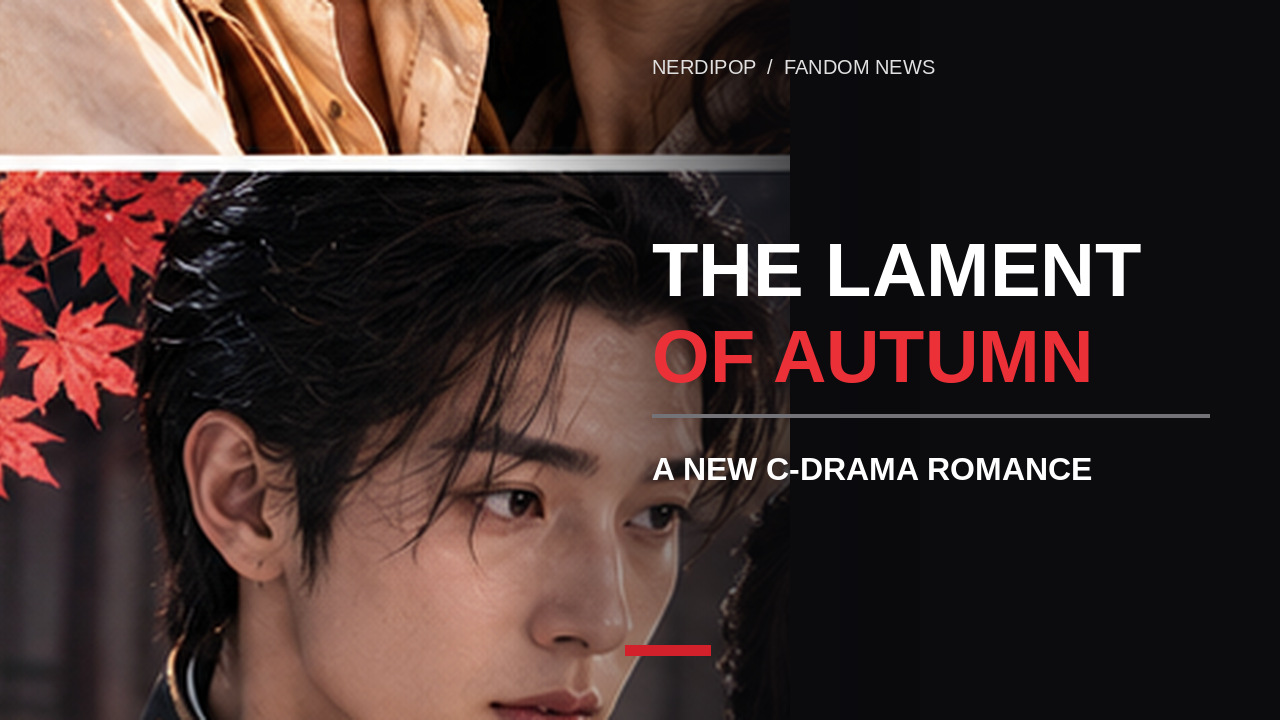
The Lament of Autumn – why this new Chinese period romance is attracting attention
Chinese period dramas have long attracted viewers with their elaborate costumes, emotionally complicated romances and stories of characters caught between personal desires and powerful social expectations. While historical fantasy productions frequently explore imperial courts and mythical kingdoms, dramas set during China’s Republican era offer a different atmosphere, combining the elegance of early twentieth-century fashion with military conflict, political instability and changing social traditions.
The Lament of Autumn, also known by its Chinese title Yu Dian Qiu (玉簟秋), is the latest production to explore that world.
Starring Cheng Lei and Xu Ruohan, the series premiered on Hunan TV and Mango TV on 12 October 2026. Adapted from a novel by Ling Xi, the drama follows a young military commander and a female student whose complicated relationship develops against the background of political turmoil in 1920s China.
Its mixture of romance, conflicting loyalties and a turbulent historical setting makes it an interesting addition to the October C-drama schedule, particularly for audiences who enjoy emotionally intense period relationships.
What is The Lament of Autumn about?
The story follows Yu Changxuan, a young military commander portrayed by Cheng Lei, and Ye Pingjun, a female student played by Xu Ruohan.
Their lives intersect during a period of political instability, introducing them to a relationship shaped by very different social positions, personal ambitions and expectations.
Yu Changxuan occupies a position associated with military influence and authority, while Ye Pingjun belongs to a younger generation attempting to navigate an uncertain society.
Their circumstances are complicated by the wider political conflict surrounding them, as personal relationships become entangled with questions of loyalty, family responsibilities and competing ambitions.
According to Mango TV’s official synopsis, the drama explores the emotional consequences of their encounter and the obstacles created by their differing positions within society.
The series combines romance with military and political themes, suggesting that the characters’ relationship will be shaped by more than ordinary misunderstandings.
Although the drama features familiar romantic conventions, its setting creates opportunities to explore how individuals respond when their personal desires conflict with the demands of an unstable society.
Why the Republican era is such an interesting setting
The Republican era in Chinese history began in 1912 following the collapse of the Qing dynasty and continued until the establishment of the People’s Republic of China in 1949.
It was a period of significant political, social and cultural change, including military conflicts, regional struggles for power and debates about China’s future.
For television dramas, the period provides a distinctive visual and narrative environment.
Traditional clothing existed alongside Western-influenced fashion, while cities increasingly reflected the influence of modern education, international trade and technological developments.
Characters in these stories may encounter changing attitudes towards marriage, women’s education, personal independence and family responsibility.
At the same time, military and political conflicts can place enormous pressure on personal relationships.
A romance involving a military commander and a student naturally lends itself to stories about differences in status, power and individual freedom.
However, fictional Republican-era dramas should not be treated as comprehensive representations of the historical period. They frequently combine historical atmosphere with invented characters and highly romanticised situations.
Cheng Lei takes on another complicated character
Cheng Lei has attracted increasing attention among international C-drama viewers through performances that combine restrained emotion with strong screen presence.
One of his most recognisable roles is Gong Shangjue in My Journey to You, where he portrayed a serious and formidable character whose personal relationships were shaped by duty and complicated family circumstances.
He also appeared in Legend of the Female General, expanding his experience with historical romance and military-themed storytelling.
In The Lament of Autumn, his role as Yu Changxuan provides another opportunity to portray a character balancing authority, personal desires and responsibilities.
The young commander’s status within the military establishment introduces complications that extend beyond a conventional romantic relationship.
His decisions may affect not only his own future but also the lives of people connected to him through family and political obligations.
For viewers familiar with Cheng Lei’s previous performances, the role offers an opportunity to see how he approaches another character whose public authority may conflict with his private emotions.
Xu Ruohan’s Ye Pingjun
Xu Ruohan plays Ye Pingjun, a female student whose encounter with Yu Changxuan changes the direction of her life.
The character’s educational background is particularly relevant to the drama’s historical setting.
The early twentieth century was a period in which questions about women’s education, personal independence and changing social roles were becoming increasingly significant in Chinese society.
Although the drama is a fictional romance, Ye Pingjun’s position offers opportunities to explore the conflict between individual aspirations and traditional expectations.
A compelling version of the character would need to establish her ambitions and decisions beyond her relationship with the male lead.
For audiences who enjoy strong female protagonists, this will be an important element to watch as the story develops.
Why power differences matter in period romance
One of the recurring conventions of Republican-era romance is the relationship between a powerful military figure and a woman whose social position gives her comparatively limited influence.
Such stories can create considerable dramatic tension, particularly when the characters come from different backgrounds or disagree about their responsibilities.
However, these relationships also raise questions about agency and consent, especially when one character possesses substantial political or military authority.
For modern audiences, the success of this kind of romance often depends on how convincingly the writers develop both characters.
A relationship becomes more engaging when the female lead has meaningful choices, personal ambitions and an identity beyond the decisions of the male protagonist.
It is also important for the drama to distinguish between behaviour that is intended to be romantic and behaviour that creates genuine conflict or danger.
These tensions can be part of compelling storytelling, but they require thoughtful development if the characters are to remain believable.
How does it compare with other Chinese period dramas?
Audiences who enjoy productions such as The Rebel Princess, Arsenal Military Academy and Siege in Fog may recognise some of the themes associated with The Lament of Autumn, although these series differ substantially in their settings and storytelling approaches.
Republican-era dramas often combine emotional relationships with espionage, military conflict or political rivalries.
That distinguishes them from xianxia productions, where the conflicts frequently involve immortals, supernatural powers and mythical realms.
It also gives them a different atmosphere from palace dramas centred on imperial families and succession disputes.
The appeal lies in the combination of romance with a society undergoing dramatic change, where relationships may be affected by war, social status and competing loyalties.
For viewers looking for something different from another fantasy romance, the Republican-era setting can be particularly attractive.
Where can you watch The Lament of Autumn?
The series began airing on Hunan TV and Mango TV on 12 October 2026.
Mango TV’s official listings identify Cheng Lei and Xu Ruohan as the leading performers and provide access to episodes, trailers and promotional material.
International availability may differ by region, and subtitles should be checked through the official platform before assuming that a particular language is supported.
Although early platform information confirms the drama’s release and premise, it does not by itself establish that the series has become a major ratings success or international hit.
Those conclusions would require more substantial audience measurements and reception data.
Is The Lament of Autumn worth adding to your watchlist?
For viewers who enjoy emotionally intense romances, military intrigue and historical settings, The Lament of Autumn has several appealing ingredients.
Its central relationship brings together two characters occupying very different positions in a society experiencing significant political change.
The performances of Cheng Lei and Xu Ruohan will be important, but the drama’s success will ultimately depend on the strength of its writing.
A complicated romance is most compelling when the characters’ decisions make sense within their circumstances and their relationship develops through meaningful emotional conflict.
The historical setting also creates opportunities to tell a story about responsibility, identity and the difficulty of maintaining personal relationships during uncertain times.
For now, The Lament of Autumn is a promising new addition to the C-drama schedule rather than an established breakout hit.
Its eventual reputation will depend on whether the story can maintain the balance between romance, character development and political intrigue.
Do you prefer Chinese historical fantasy dramas filled with mythology and supernatural powers, or Republican-era romances with military intrigue and complicated relationships?
Share this article
