
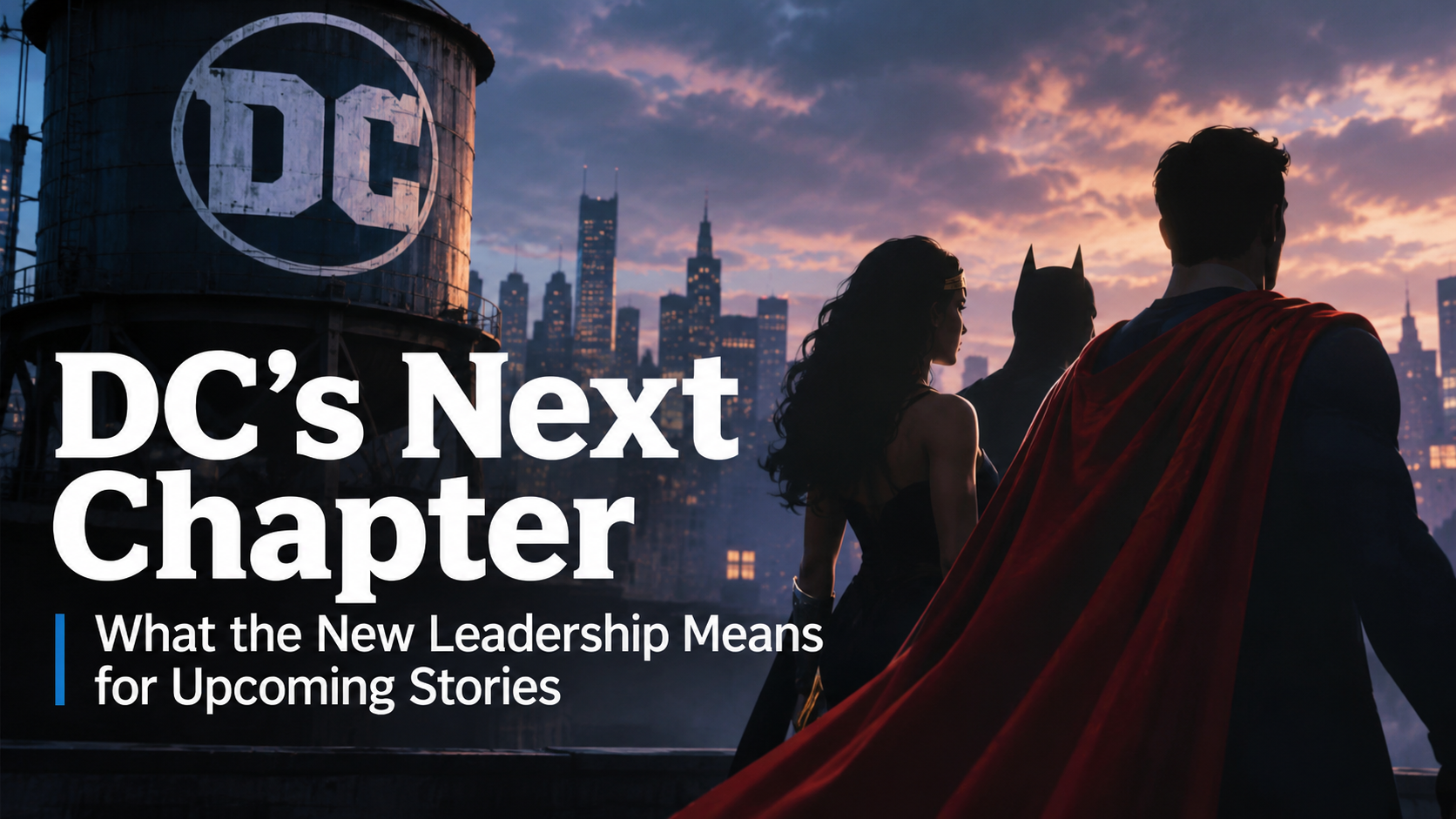
DC Studios Enters a New Chapter: What Does the Leadership Change Mean for Superman, Batman and the DC Universe?
DC Studios is preparing for a major leadership change as Marvel veteran Jeremy Latcham takes over from James Gunn and Peter Safran. But does this signal another DC reboot, or could it finally bring the stability fans have been hoping for?
Just when DC fans thought the studio had settled into its new cinematic direction, another major announcement has shaken things up.
On 9 November 2026, Skydance announced that Jeremy Latcham would become President and Chief Creative Officer of DC Studios, effective 1 December 2026.
James Gunn and Peter Safran, who have overseen the studio’s creative transformation since 2022, will step away from their leadership positions to concentrate on creative work.
For a franchise that has experienced numerous changes in direction, the announcement naturally raises questions.
What happens to Superman? Will Batman’s future be affected? And does this mean the DC Universe is heading towards another reboot?
Fortunately, the official announcement provides some clarity, even if many questions remain unanswered.
Who is Jeremy Latcham?
Jeremy Latcham brings considerable experience in superhero filmmaking, having worked on some of Marvel Studios’ most important productions.
His credits include Iron Man, The Avengers, Avengers: Age of Ultron and Spider-Man: Homecoming.
These films helped establish the Marvel Cinematic Universe as an interconnected collection of stories, where individual characters could develop their own identities while contributing to a larger narrative.
That experience will be valuable at DC Studios, which faces the ongoing challenge of balancing individual superhero stories with an ambitious shared universe.
But DC isn’t Marvel.
Its characters, mythology and storytelling traditions are different, and the studio’s success will depend on recognising those differences.
What happens to James Gunn and Peter Safran?
The most important distinction is that Gunn and Safran are leaving their management roles, not necessarily abandoning the DC projects they have helped develop.
When the pair took charge of DC Studios in 2022, they inherited a complicated situation.
The previous DC Extended Universe had produced major successes, including Wonder Woman and Aquaman, but it had also struggled with inconsistent continuity, mixed audience responses and uncertainty about the future of several leading characters.
Gunn and Safran introduced a new interconnected universe, beginning with Creature Commandos and expanding through Superman, Peacemaker and additional projects.
Their approach aimed to establish a more consistent creative identity across film, television and animation.
Now, after four years, they are returning their attention to creative work.
The official announcement emphasises a collaborative transition rather than a complete break with the previous strategy.
What does this mean for Superman?
Superman remains one of DC’s most important characters, and James Gunn’s 2025 film helped introduce a new version of the Man of Steel.
Starring David Corenswet as Clark Kent, the film moved away from some of the darker interpretations of previous years and placed renewed emphasis on Superman’s compassion, optimism and belief in humanity.
It also established a wider superhero world.
Characters such as Mister Terrific, Hawkgirl and Guy Gardner demonstrated that Superman was operating within a universe already populated by extraordinary individuals.
This was an important creative decision.
Rather than requiring audiences to watch numerous origin stories before the characters could interact, DC introduced a world in which superheroes already existed.
The leadership change does not automatically undo that foundation.
However, fans will understandably want reassurance about the future of Superman’s story and Gunn’s continued creative involvement.
Batman presents a different challenge
Batman is arguably DC’s most flexible character.
He can appear in grounded detective stories, psychological thrillers, gothic adventures or large-scale superhero productions.
The character’s versatility has allowed filmmakers to develop very different interpretations.
Christopher Nolan’s The Dark Knight trilogy approached Batman through crime drama and realism, while Matt Reeves’ The Batman emphasised detective work, corruption and Gotham City’s darker atmosphere.
Meanwhile, the interconnected DC Universe has plans for its own Batman.
The challenge for studio leadership is ensuring that these interpretations remain clear to audiences.
A separate Batman film can offer an excellent cinematic experience without necessarily connecting to the wider DC Universe.
But viewers need to understand which stories belong together and which exist independently.
That balance between shared continuity and standalone storytelling will be an important part of DC’s future.
What about Lanterns, Supergirl and the other DC projects?
DC’s universe extends far beyond its best-known characters.
Lanterns offers opportunities for cosmic science fiction and investigative storytelling through the Green Lantern mythology.
Supergirl brings a different perspective to the legacy of Krypton and the responsibilities of extraordinary power.
Meanwhile, projects involving characters such as Clayface demonstrate DC’s willingness to explore genres beyond traditional superhero adventures.
This variety is one of the franchise’s greatest strengths.
A Superman film doesn’t have to resemble a Batman detective mystery.
A supernatural DC story doesn’t need to follow the formula of a cosmic superhero adventure.
The challenge is allowing each production to develop its own identity while maintaining enough consistency to make the shared universe meaningful.
Is another DC reboot coming?
There has been no official announcement that the leadership change will result in another complete reboot.
That is an important point.
Fans have experienced years of conflicting reports, abandoned projects and shifting plans, so speculation is understandable.
But a new executive appointment does not automatically mean existing productions will be cancelled or characters recast.
At this stage, the confirmed change concerns studio leadership.
Any future alterations to individual projects should be assessed when they are officially announced.
Why DC needs stability more than another fresh start
The greatest challenge facing DC Studios may not be finding exciting new ideas.
DC already has an extraordinary collection of characters and stories.
Its comics have produced decades of influential storytelling, from cosmic adventures and detective mysteries to mythology, horror and alternative universes.
The challenge is building audience confidence.
Viewers need to feel that investing in a character’s story is worthwhile and that future instalments will have a meaningful direction.
A shared universe becomes difficult to follow when the foundations are repeatedly replaced.
At the same time, creative consistency should not come at the expense of originality.
The most promising future for DC may be one where filmmakers are encouraged to explore different genres while working within a clear overall strategy.
What comes next?
Jeremy Latcham officially assumes leadership on 1 December 2026.
The real impact of his appointment will become clearer as future production decisions, development plans and release announcements emerge.
For now, the most encouraging aspect of the announcement is the emphasis on continuity and collaboration.
James Gunn and Peter Safran helped establish the current DC Universe. The new leadership now has an opportunity to develop those foundations further.
Whether that results in a stronger, more consistent franchise remains to be seen.
But after years of uncertainty, DC fans have one reasonable hope.
Let the characters grow, give their stories room to develop and allow the universe to move forward.
What do you think DC should prioritise next: Superman, Batman, Wonder Woman or some of its lesser-known heroes?
Share this article
