
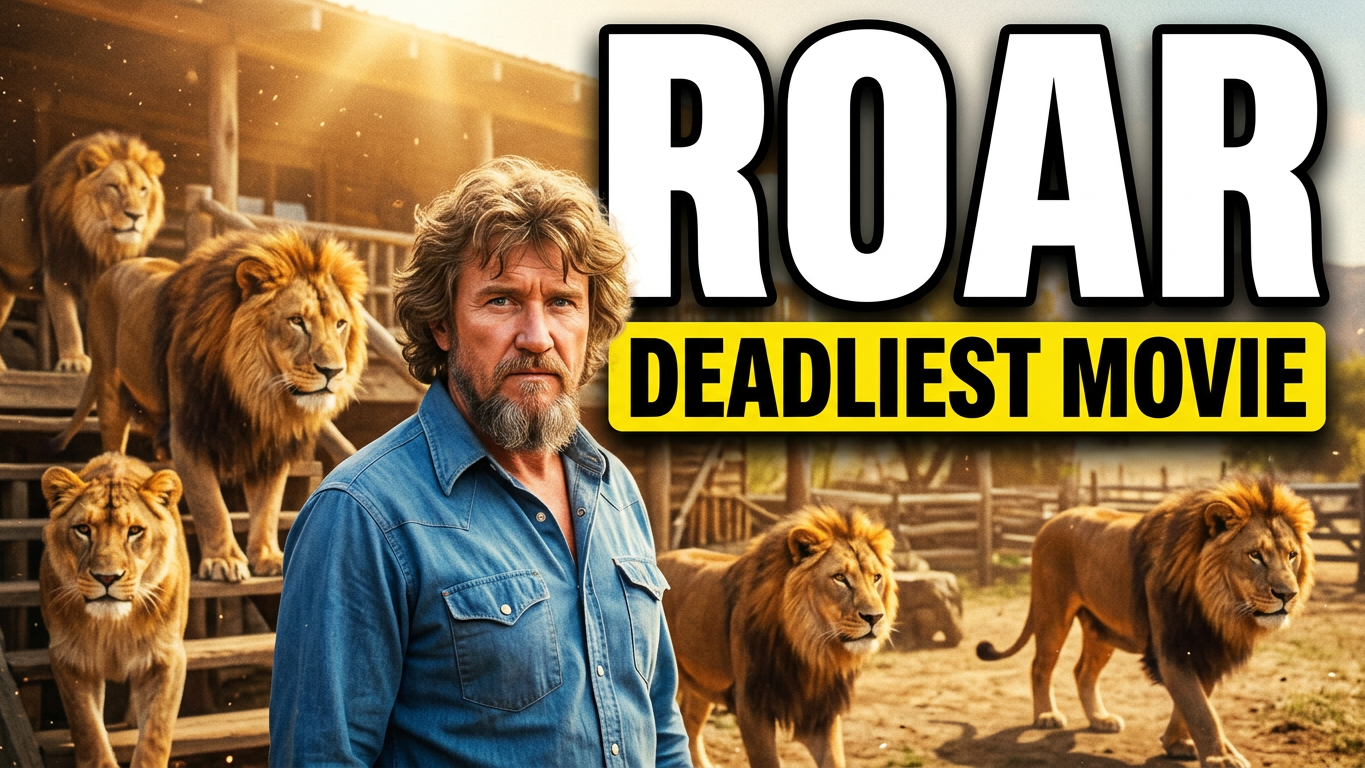
Roar (1981): The terrifying true story behind the most dangerous movie ever made
Hollywood has produced some notoriously dangerous films, from productions involving death-defying stunts to disasters that nearly destroyed entire movie sets. But few can compare to the extraordinary chaos surrounding Roar, the 1981 adventure film that put its cast and crew face-to-face with dozens of untrained lions, tigers and other big cats.
What was supposed to be a heartwarming celebration of wildlife became one of the most hazardous productions in cinema history. Actors were mauled, crew members suffered horrific injuries, natural disasters devastated the set and millions of dollars disappeared into a project that seemed determined never to end.
Perhaps most astonishing of all, despite an estimated 70 cast and crew injuries, nobody was killed during filming.
The story behind Roar is so unbelievable that it almost sounds like a fictional Hollywood horror movie. Unfortunately for the people involved, the danger was very real.
Not in the mood to read? Watch the video here.
Looking for some really awesome merchandise? Visit our Red Bubble store.
From a love of animals to a Hollywood nightmare
The extraordinary story of Roar began in 1969, when actress Tippi Hedren and her husband, film producer Noel Marshall, visited Africa. During their travels, they encountered lions occupying an abandoned house, an experience that inspired an ambitious idea: create a film demonstrating that humans and big cats could live together peacefully.
Hedren, already famous for starring in Alfred Hitchcock’s The Birds, shared Marshall’s fascination with the animals. The couple began acquiring and caring for big cats at their California home, eventually establishing an extensive collection of lions, tigers and other exotic animals.
Their original intentions centred on wildlife appreciation and conservation. However, their increasingly unconventional approach to living with powerful predators laid the foundations for a filmmaking experiment unlike anything Hollywood had attempted.
Rather than using trained animals and carefully controlled sequences, Marshall wanted the cats to behave naturally on camera. The actors would simply interact with them, allowing the animals’ unpredictable behaviour to shape the scenes.
It was a remarkable idea, but also an extraordinarily dangerous one.
And although the story took place in Africa, the movie itself was primarily filmed at the family’s property in Acton, California, which had been transformed into an African-style wildlife preserve.
What was Roar actually about?
Released internationally in 1981, Roar follows Hank, a wildlife enthusiast played by Noel Marshall, who lives in Africa surrounded by a large collection of lions, tigers and other animals.
When his wife Madeleine, played by Tippi Hedren, arrives with their children, they discover that Hank’s unusual companions have effectively taken over the house.
What follows is a chaotic series of encounters involving enormous cats wandering through bedrooms, chasing people around furniture, climbing over cars and generally behaving as though the entire property belongs to them.
The film also stars Melanie Griffith, Hedren’s real-life daughter, alongside Marshall’s sons John and Jerry.
On paper, the premise sounds like an eccentric family adventure, perhaps even a comedy. On screen, however, the distinction between playful animal behaviour and genuine danger becomes alarmingly difficult to recognise.
Many scenes show the actors being surrounded, knocked over or chased by animals that were not following conventional film directions.
The tension comes from knowing that these were real animals, behaving unpredictably in a setting where the consequences could be devastating.
The attacks that made Roar infamous

Melanie Griffith suffered one of the production’s best-known attacks when a lion mauled her face. She reportedly required approximately 50 stitches and reconstructive surgery around her eye. She subsequently returned to the production despite the terrifying experience.
Cinematographer Jan de Bont, who would later become famous for directing Speed and Twister, suffered an equally horrifying encounter.
A lion attacked him and tore part of his scalp away. Reports differ on the exact number of stitches required, with accounts ranging from around 120 to more than 200. Remarkably, de Bont recovered and returned to work on the film.
Noel Marshall himself was repeatedly attacked and bitten. His injuries became so severe that he developed gangrene, and he required extensive medical treatment.
Tippi Hedren also suffered injuries, including a fractured leg after an encounter with an elephant.
Assistant director Doron Kauper sustained serious injuries during another lion attack, while Marshall’s son John was bitten on the head in an incident that reportedly took several men to bring under control.
Yet the cameras continued rolling.
According to accounts from those involved, Marshall was determined to capture dramatic footage, sometimes allowing filming to continue even when the actors were visibly frightened or in distress.
By the end of production, the number of injured cast and crew members was estimated at 70, although some people involved have suggested the real figure was higher.
Even nature seemed determined to stop production

As though the constant threat of animal attacks wasn’t enough, Roar encountered a succession of devastating disasters.
In February 1978, severe flooding struck the California property, destroying substantial portions of the set and equipment. Enclosures were damaged, animals escaped and the production faced enormous financial losses.
The situation was particularly dangerous because escaped predators presented a threat beyond the film set. Several animals were killed by authorities during the emergency.
A subsequent wildfire created further problems, forcing the evacuation of animals and threatening the entire project.
Filming also suffered from financial difficulties, unpredictable weather, animal illnesses and staff departures.
A production originally expected to take months eventually consumed approximately five years of filming, with the broader development process extending over roughly 11 years.
The film’s budget reportedly ballooned to around $17 million, an extraordinary sum for an independently financed project.
For a movie about people living peacefully alongside wildlife, the behind-the-scenes reality could hardly have been more chaotic.
A $17 million movie that became a box office disaster

By the time Roar finally reached international cinemas in 1981, its remarkable production history had already overshadowed the film itself.
Despite its enormous budget, the movie struggled commercially, with commonly reported worldwide earnings of approximately $2 million.
It also faced criticism for its loose storyline, unusual pacing and chaotic structure.
In many ways, the problem was inevitable. The filmmakers had built an entire production around animals that could not reliably follow instructions.
Traditional filmmaking depends on actors hitting their marks, repeating scenes and responding to direction. Lions and tigers, unsurprisingly, had very different priorities.
The result was a film that sometimes feels more like a collection of unpredictable animal encounters than a carefully structured adventure.
However, that same unpredictability would eventually become the reason audiences rediscovered it.
In 2015, Roar received a United States theatrical release through Drafthouse Films, introducing it to a new generation of moviegoers.
Its reputation as one of the most dangerous films ever made became its biggest attraction.
For modern audiences accustomed to computer-generated animals and elaborate safety procedures, the sight of actors interacting with enormous predators is both fascinating and deeply unsettling.
The legacy of Roar: A film that could never be made the same way today
Perhaps the most complicated part of Roar’s legacy is the contradiction at its heart.
Marshall and Hedren wanted to encourage respect and appreciation for big cats. Their film was intended to challenge negative perceptions of predators and promote the idea that humans could coexist with wildlife.
Yet the production exposed the dangers of treating powerful wild animals as though they were domesticated companions.
Following the film, Hedren continued her involvement in big-cat welfare. In 1983, she established the nonprofit Roar Foundation, associated with the Shambala Preserve in California.
Her later conservation work became an important part of her public life, even as the film itself remained controversial.
Today, Roar occupies a strange position in cinema history. It is simultaneously an unusual wildlife adventure, an independent filmmaking curiosity and a cautionary tale about what can happen when artistic ambition overwhelms safety considerations.
The animals were never the villains. They were simply behaving like wild animals.
The real problem was the decision to place people in situations where those natural behaviours could cause catastrophic injuries.
And that is what makes the story of Roar so unforgettable.
10 fascinating facts about Roar (1981)
1. It was filmed in California, not Africa. Although the story takes place on an African wildlife preserve, most filming occurred on the Marshall family’s property in Acton, California.
2. The film featured more than 100 big cats. The filmmakers worked with an extraordinary collection of lions, tigers and other animals, most of which were not trained film performers.
3. Melanie Griffith required reconstructive surgery. A lion attack left the young actress with facial injuries, but she eventually returned to filming.
4. A future Hollywood blockbuster director was seriously injured. Cinematographer Jan de Bont was attacked by a lion and required extensive stitches to his scalp. He later directed Speed and Twister.
5. Noel Marshall developed gangrene. Repeated bites and injuries left the filmmaker facing serious medical complications.
6. The film cost approximately $17 million. Its enormous production costs earned it a reputation as one of cinema’s most extravagant family passion projects.
7. A flood devastated the production. In 1978, severe flooding destroyed sets, damaged equipment and caused animals to escape from their enclosures.
8. The big cats dictated the filming schedule. The filmmakers sometimes waited hours for the animals to do something useful, only for important moments to happen before the cameras were ready.
9. Around 70 people were reportedly injured. Despite the astonishing number of injuries, there were no human fatalities during filming.
10. It found a new audience decades later. The 2015 American theatrical release transformed Roar into a cult attraction, with viewers drawn to its extraordinary and dangerous production history.
Was Roar worth the risk?
There is no denying that Roar is unlike almost anything else in cinema. It captures extraordinary footage of big cats behaving naturally around people, creating moments of genuine unpredictability that no special effects team could easily reproduce.
But its story also raises an uncomfortable question: how far should filmmakers go in pursuit of authenticity?
With dozens of injuries, repeated animal attacks, destroyed sets and massive financial losses, Roar demonstrated just how dangerous filmmaking can become when basic safety principles are disregarded.
More than four decades after its release, the movie remains fascinating not because of its plot or performances, but because of the incredible circumstances under which it was created.
It was meant to show the beauty of wild animals. Instead, it became a lasting reminder of why wild animals deserve respect, distance and proper protection.
Have you ever watched Roar? Would knowing what happened behind the scenes make you more curious to see it, or would it put you off completely?
Share your thoughts in the comments, and follow NerdiPop for more fascinating stories about movies, television, fandoms and the extraordinary history of entertainment.
Share this article
