
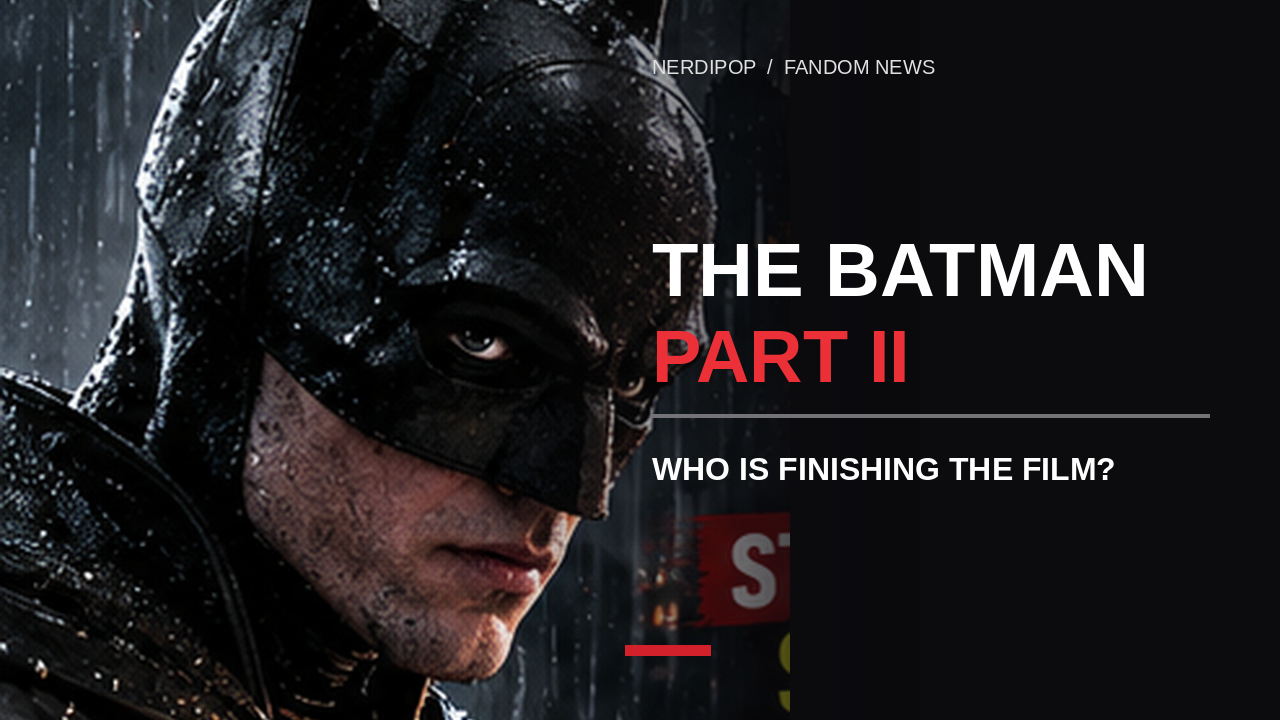
The Batman Part II – why Steven Soderbergh is stepping in and what it means for Matt Reeves’ Gotham
The road back to Gotham has taken another unexpected turn. With anticipation continuing to build around The Batman Part II, Warner Bros. and DC Studios have confirmed a significant behind-the-scenes development involving two of Hollywood’s most respected filmmakers.
Oscar-winning director Steven Soderbergh is stepping in to help complete the final weeks of principal photography while Matt Reeves attends to a private family matter. The news, confirmed by studio representatives and reported by Variety on 16 October 2026, immediately raised questions among fans about whether Reeves was leaving the sequel.
However, the situation is considerably different from the dramatic director replacement some headlines might suggest. Reeves has explicitly stated that he is not leaving The Batman Part II, while Soderbergh has explained that his responsibility is to help complete the remaining footage in a manner consistent with Reeves’ established vision.
For a film whose atmosphere, visual identity and distinctive interpretation of Batman were among the defining elements of its predecessor, that distinction is particularly important.
What exactly has happened to The Batman Part II?
Production on the sequel was temporarily paused in early October after Matt Reeves stepped away to attend to a family matter. Warner Bros. and DC Studios publicly expressed their support for the filmmaker, explaining that the pause would allow him to focus on his personal responsibilities.
On 16 October, the studios confirmed that Steven Soderbergh would assist with the remaining weeks of principal photography. According to the official statement, Soderbergh approached Reeves about helping him complete the work, with both filmmakers intending to collaborate closely alongside the cast and production team.
Soderbergh praised Reeves’ work on the first film and emphasised the importance of ensuring that the newly filmed material integrates naturally with the existing footage.
Reeves also addressed the situation publicly, clarifying that he remains involved in the project and expressing gratitude for Soderbergh’s assistance during a difficult period.
The arrangement means that Soderbergh is taking responsibility for completing part of the filming process, not taking over the entire creative direction of the sequel. Reeves remains the filmmaker whose vision the production intends to preserve, and he is expected to oversee post-production.
The specific circumstances of his family matter have not been disclosed in detail, and there is no need to speculate about them.
Why Matt Reeves’ Batman is so distinctive
When The Batman arrived in March 2022, it introduced audiences to a version of Gotham City that felt different from many previous cinematic interpretations.
Rather than concentrating on an experienced superhero facing increasingly spectacular threats, Reeves explored a younger Bruce Wayne still developing his identity as Batman. Robert Pattinson portrayed a deeply isolated character whose obsession with fighting crime had consumed much of his personal life.
The film followed Batman’s investigation into a series of murders committed by the Riddler, played by Paul Dano. As the investigation unfolded, Batman discovered disturbing connections between Gotham’s political establishment, organised crime and his own family’s history.
The detective-story structure was central to the film’s appeal. Reeves drew inspiration from crime thrillers and noir cinema, creating a Gotham characterised by persistent rain, shadowy interiors, corruption and an almost overwhelming sense of urban decay.
Greig Fraser’s cinematography helped establish the visual identity, while Michael Giacchino’s score contributed to the atmosphere of menace and melancholy.
The result was a superhero film that often felt closer to a serial-killer thriller than a conventional comic-book blockbuster. Its relatively grounded tone and emphasis on investigation gave Pattinson’s Batman a distinctive place alongside earlier interpretations by Michael Keaton, Christian Bale and Ben Affleck.
For fans who appreciated that approach, maintaining Reeves’ creative direction is understandably important.
Who is Steven Soderbergh?
Steven Soderbergh is one of the more versatile directors working in modern cinema, with a career spanning independent films, major studio productions, crime thrillers, dramas and experimental filmmaking.
He first attracted significant attention with Sex, Lies, and Videotape in 1989, a film that became an important landmark in American independent cinema. He later directed Erin Brockovich and Traffic, winning the Academy Award for Best Director for the latter.
His commercial work includes Ocean’s Eleven, Ocean’s Twelve and Ocean’s Thirteen, which demonstrated his ability to manage elaborate ensemble casts, complicated narrative structures and stylish filmmaking on a large scale.
More recent productions such as Presence and Black Bag have further demonstrated his interest in experimenting with perspective, genre and visual storytelling.
Although Soderbergh’s films do not necessarily resemble Reeves’ interpretation of Batman, his technical experience and adaptability are particularly relevant to the current situation.
Completing footage for a film that has already established a strong visual and narrative identity requires a different approach from directing a project entirely from the beginning. The objective is not to introduce a competing interpretation, but to work within an existing production plan and maintain consistency.
Soderbergh’s stated intention is to do precisely that.
Why Batman fans are remembering Justice League
Any major change involving a director on a DC production is likely to remind audiences of the controversy surrounding Justice League.
In 2017, Zack Snyder stepped away from the superhero ensemble film following a family tragedy, and Joss Whedon was brought in to complete the production.
The finished theatrical version became controversial because of its altered tone, additional photography and differences from Snyder’s original plans. Fan dissatisfaction eventually contributed to the release of Zack Snyder’s Justice League in 2021.
That history helps explain why some viewers are uneasy about another director becoming involved in an established DC project.
However, the similarities should not be exaggerated.
In the case of The Batman Part II, the studios have publicly described Soderbergh’s involvement as a collaborative arrangement intended to preserve Reeves’ vision. Reeves himself has confirmed that he is not leaving the film, while Soderbergh has specifically emphasised the importance of matching the footage already completed.
There is currently no verified evidence of a creative dispute, an alternative script or plans to transform the film into something substantially different from what Reeves intended.
The fact that another filmmaker is assisting with production should not automatically be interpreted as evidence of creative turmoil.
What do we know about the sequel?
Robert Pattinson returns as Bruce Wayne and Batman, continuing the interpretation introduced in the 2022 film.
The reported cast includes several returning performers, among them Colin Farrell as Oswald Cobblepot, Andy Serkis as Alfred Pennyworth and Jeffrey Wright as James Gordon. Scarlett Johansson and Sebastian Stan are also among the actors joining the production.
The sequel follows a period of expansion for Reeves’ version of Gotham, particularly after the success of the HBO television series The Penguin, which explored the city’s criminal underworld following the events of the first film.
That series demonstrated how Gotham could support compelling stories beyond Batman himself, giving audiences a deeper understanding of its organised crime networks, rivalries and shifting power structures.
Although some casting and production information has been confirmed, the precise storyline of The Batman Part II remains largely under wraps. Fans should therefore be cautious about theories concerning the main villain, the role of new characters or possible connections to the wider DC universe.
The sequel is part of Reeves’ established Batman continuity rather than the main interconnected DC Universe being developed under James Gunn and Peter Safran.
Will the production change affect the release date?
The Batman Part II remains scheduled for theatrical release on 18 February 2028.
The film has already experienced several release-date changes since its initial announcement. It was originally associated with an October 2026 release before moving to October 2027 and subsequently February 2028.
At present, the announcement involving Soderbergh has not been accompanied by another confirmed postponement.
That does not guarantee that every stage of production will proceed without further adjustments, but speculation about additional delays would be premature.
The more immediate priority is completing principal photography while allowing Reeves to continue working on the film under the circumstances described by the studio.
Can two directors preserve one vision?
Film production is inherently collaborative, involving cinematographers, production designers, editors, composers, performers and numerous other creative professionals.
Although the director usually provides the central creative direction, filmmaking is rarely the work of one person operating independently.
When a production is already well established, many of its visual and narrative decisions have been made. Sets, costumes, lighting approaches, character performances and much of the cinematographic language will already exist.
That gives an experienced filmmaker such as Soderbergh an established framework within which to work.
The challenge will be ensuring that the remaining material feels consistent with the footage Reeves has directed, particularly in scenes where camera movement, lighting and performance are central to the film’s atmosphere.
Ultimately, audiences will judge the completed film rather than the production arrangement itself.
What this means for Gotham’s future
The news surrounding The Batman Part II is certainly unusual, particularly for a major superhero production approaching the end of principal photography. However, the confirmed circumstances suggest a practical effort to support a filmmaker while keeping an important production moving forward.
Matt Reeves has not announced his departure, and Steven Soderbergh has not been presented as a replacement creative lead. Both filmmakers have expressed a shared commitment to completing the film in accordance with Reeves’ existing vision.
For fans, the real question is whether the sequel can build upon the strengths of the original: its compelling detective story, memorable performances, atmospheric Gotham and psychologically complex interpretation of Bruce Wayne.
The involvement of another respected director may create uncertainty, but it does not automatically threaten those qualities.
For now, Gotham’s future remains in the hands of a creative team that appears determined to finish the film Reeves set out to make.
Do you think another director can successfully help complete a film without changing its identity, or would you prefer a production to pause until its original director can return?
Share this article
