
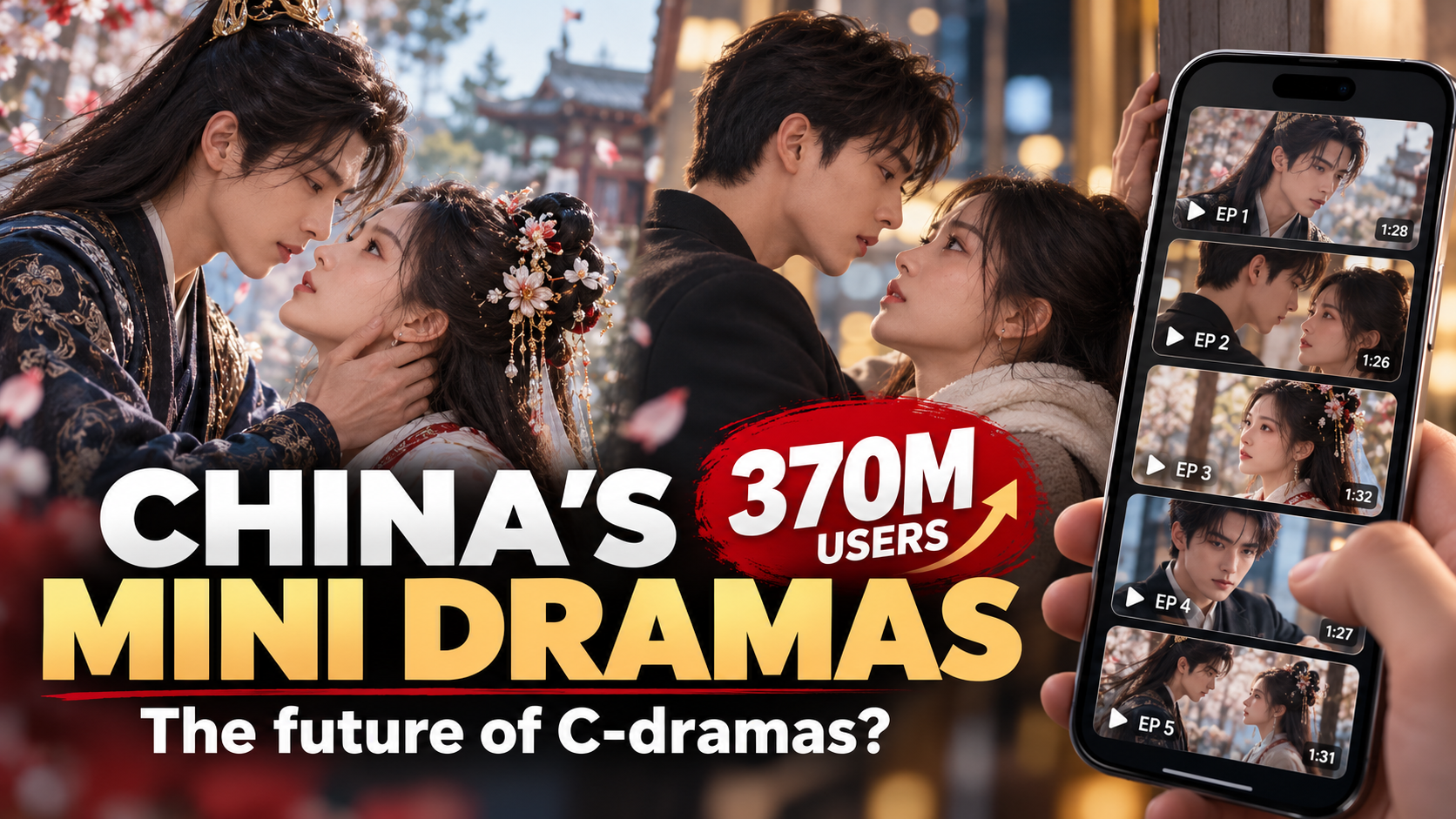
China’s mini dramas are taking over – is this the future of C-dramas?
Chinese dramas have become increasingly popular with international audiences, attracting viewers who enjoy elaborate historical romances, intricate fantasy worlds and emotionally charged relationships. Productions such as Love Between Fairy and Devil, The Untamed and Till the End of the Moon have helped introduce viewers to storytelling traditions that combine romance, mythology and spectacular visual design.
But while international fans continue discovering these long-form productions, another form of Chinese entertainment is growing at an extraordinary pace. Micro-dramas, frequently consisting of episodes lasting only a few minutes, are attracting enormous audiences through mobile-first streaming platforms.
According to a Business Insider report published on 16 October 2026, ByteDance’s Hongguo short-drama app had reached nearly 370 million users by June, demonstrating the growing scale of an entertainment sector that has become an important part of China’s digital media landscape.
The development raises some fascinating questions about the future of Asian entertainment. Could short-form dramas eventually challenge conventional television series, and what does their popularity mean for audiences who love the elaborate storytelling of traditional C-dramas?
What exactly are Chinese micro-dramas?
Known in China as duanju, micro-dramas are scripted productions designed around short episodes, often filmed and presented vertically for smartphone viewing. Individual instalments may last only a few minutes, but a complete series can contain dozens of episodes, allowing the overall story to unfold across a substantial amount of viewing time.
The format is particularly associated with fast-moving romance, family conflict, revenge, fantasy and melodrama. Popular storylines frequently feature secret marriages, hidden identities, powerful business executives, betrayed heroines and characters who return to confront those who have wronged them.
Historical and fantasy productions also borrow familiar conventions from traditional C-dramas, including reincarnation, palace intrigue, supernatural abilities and second chances at life. These themes will be immediately recognisable to anyone who regularly watches Asian romantic fantasy series.
What distinguishes micro-dramas is not necessarily their subject matter but their pacing. A conventional television drama may spend several episodes developing a relationship or establishing a complicated political conflict. A micro-drama might introduce the characters, reveal a secret and deliver a dramatic confrontation within its opening few minutes.
The format depends heavily on immediate engagement, with episodes frequently ending at moments designed to encourage viewers to continue watching.
Why are these dramas so addictive?
The appeal of micro-dramas is closely connected to how audiences consume digital entertainment. Smartphones have made it possible to watch videos almost anywhere, whether during a lunch break, while travelling or between everyday activities.
A traditional C-drama episode may require a commitment of 40 minutes or more, while a short drama provides a complete instalment in only a few minutes. This makes it easy for viewers to begin watching without feeling that they need to set aside a substantial amount of time.
However, the format also encourages continuous viewing. Episodes are structured around frequent revelations, emotional confrontations and cliffhangers, creating a cycle in which each instalment resolves one question while introducing another.
A heroine might discover her husband’s betrayal, uncover a hidden family connection and confront a powerful rival in rapid succession. Each development becomes a reason to watch the next episode, making the viewing experience far more immersive than its short running times might initially suggest.
This storytelling approach is not entirely new. Traditional soap operas, romantic serials and television cliffhangers have used similar techniques for decades. Micro-dramas adapt those familiar methods to an environment where audiences expect entertainment to be immediately accessible.
The remarkable growth of Hongguo
One of the most significant platforms in this growing market is Hongguo, a short-drama application operated by ByteDance, the company behind TikTok and Douyin.
Launched in 2023, Hongguo has attracted a substantial audience by offering a free, advertising-supported approach to micro-drama distribution. Rather than requiring viewers to pay repeatedly to unlock episodes, the platform makes large amounts of content available without a conventional subscription.
According to Business Insider’s October 2026 reporting, Hongguo had reached nearly 370 million users by June. The report also highlighted the increasing share of mobile engagement captured by ByteDance’s platforms, alongside pressure on the audience attention traditionally enjoyed by longer-form streaming services.
These figures suggest that micro-dramas have moved well beyond being a small experimental entertainment format. They now form part of a substantial digital industry with the potential to influence how scripted content is produced and distributed.
Nevertheless, the audience numbers should be interpreted carefully. The size of a platform’s user base does not necessarily mean that every user watches regularly, and it does not establish that micro-dramas have replaced conventional television viewing.
Are traditional Chinese streaming platforms under threat?
For years, companies such as iQIYI, Tencent Video and Mango TV have invested heavily in elaborate long-form Chinese dramas. Historical romances and xianxia fantasies frequently involve large production teams, elaborate costumes, extensive location filming and ambitious visual effects.
Micro-dramas operate under a different production model. Their shorter episodes, compact storytelling and mobile-oriented presentation can allow producers to create content with different budgets and production schedules.
This creates an opportunity for platforms to experiment with storylines, genres and audiences without necessarily making the same financial commitment required for a major television production.
The question is whether this represents direct competition or simply another form of entertainment that audiences can enjoy alongside traditional dramas.
Someone who watches a two-minute romantic comedy during a break may still spend an evening following an elaborate fantasy series. The two formats serve different viewing habits, even when they explore similar themes.
For streaming companies, however, the competition for attention is very real. Every minute spent watching short dramas is time that could otherwise have been spent on another entertainment platform.
Can micro-dramas deliver meaningful storytelling?
One of the most common criticisms of short-form drama is that the constant need for dramatic revelations can undermine believable character development.
A heroine may experience several betrayals within a handful of episodes, while villains behave outrageously simply to create another confrontation. Romantic relationships can also develop so quickly that viewers have little opportunity to understand why the characters are attracted to one another.
These are legitimate creative concerns, particularly for audiences who enjoy the gradual emotional development found in traditional C-dramas.
Consider Love Between Fairy and Devil, where much of the story’s impact comes from the changing relationship between Dongfang Qingcang and Xiao Lanhua. Their journey involves prejudice, emotional repression, sacrifice and a gradual transformation in how they understand one another.
Compressing that relationship into a sequence of extremely short episodes would fundamentally change the viewing experience.
However, shorter storytelling is not automatically weaker storytelling. Short films and anthology productions have demonstrated that meaningful narratives can be developed within limited running times. The challenge for micro-drama creators is to use the format effectively rather than simply accelerating every possible conflict.
A carefully written short fantasy could concentrate on a single magical mystery, while a compact historical romance might explore one important relationship without needing numerous supporting subplots.
The influence of artificial intelligence
Artificial intelligence is also becoming part of the conversation surrounding China’s micro-drama industry. Production companies are experimenting with AI-assisted technologies intended to simplify creative processes, reduce costs and accelerate the production of digital content.
These tools could potentially make certain aspects of short-form production more efficient, particularly when creators need to deliver large quantities of material within demanding schedules.
However, the growing use of AI also introduces questions about originality, employment and the quality of finished productions. Faster production does not automatically result in stronger characters or more engaging narratives.
For audiences, the most important consideration remains the entertainment itself. Viewers may be attracted by unusual premises and dramatic cliffhangers, but memorable stories still depend on convincing performances, meaningful character development and emotional engagement.
Will international audiences embrace Chinese mini dramas?
The potential for international expansion is considerable. Viewers around the world are already accustomed to watching short videos on TikTok, Instagram Reels and YouTube Shorts, while interest in Korean and Chinese dramas continues introducing new audiences to Asian storytelling.
The romantic and fantasy themes common in micro-dramas also have clear international appeal. Hidden identities, enemies-to-lovers relationships, supernatural powers and second-chance romances are familiar conventions across numerous entertainment cultures.
However, the format faces several challenges outside China. Translation quality, cultural context, distribution models and production values will all influence its reception.
Some international platforms charge viewers to unlock episodes, which could frustrate audiences accustomed to subscription services offering complete seasons. Others rely on advertising, introducing a different viewing experience from traditional streaming.
There is also the question of whether audiences who enjoy lengthy fantasy productions will find the faster pacing satisfying.
The most likely outcome may be that different formats continue developing alongside one another, appealing to viewers in different circumstances.
A new chapter in Asian entertainment
The rise of Chinese micro-dramas reflects a broader change in how audiences discover and consume entertainment. Mobile platforms have created opportunities for storytelling formats that would have been difficult to distribute through conventional television.
That development doesn’t mean traditional C-dramas are disappearing. Elaborate historical romances, fantasy epics and character-driven contemporary series offer experiences that cannot always be reproduced through short episodes.
Instead, micro-dramas may create another avenue for Asian storytelling to reach audiences worldwide.
For fans of Chinese entertainment, the expansion could mean greater variety, new creative voices and stories that experiment with different approaches to romance, fantasy and suspense.
Whether micro-dramas will become the dominant format internationally remains uncertain, but the extraordinary growth of platforms such as Hongguo suggests that they can no longer be dismissed as a passing novelty.
Would you watch a romantic fantasy C-drama told in two-minute episodes, or do you prefer full-length episodes that allow the characters and story to develop gradually?
Share this article
