
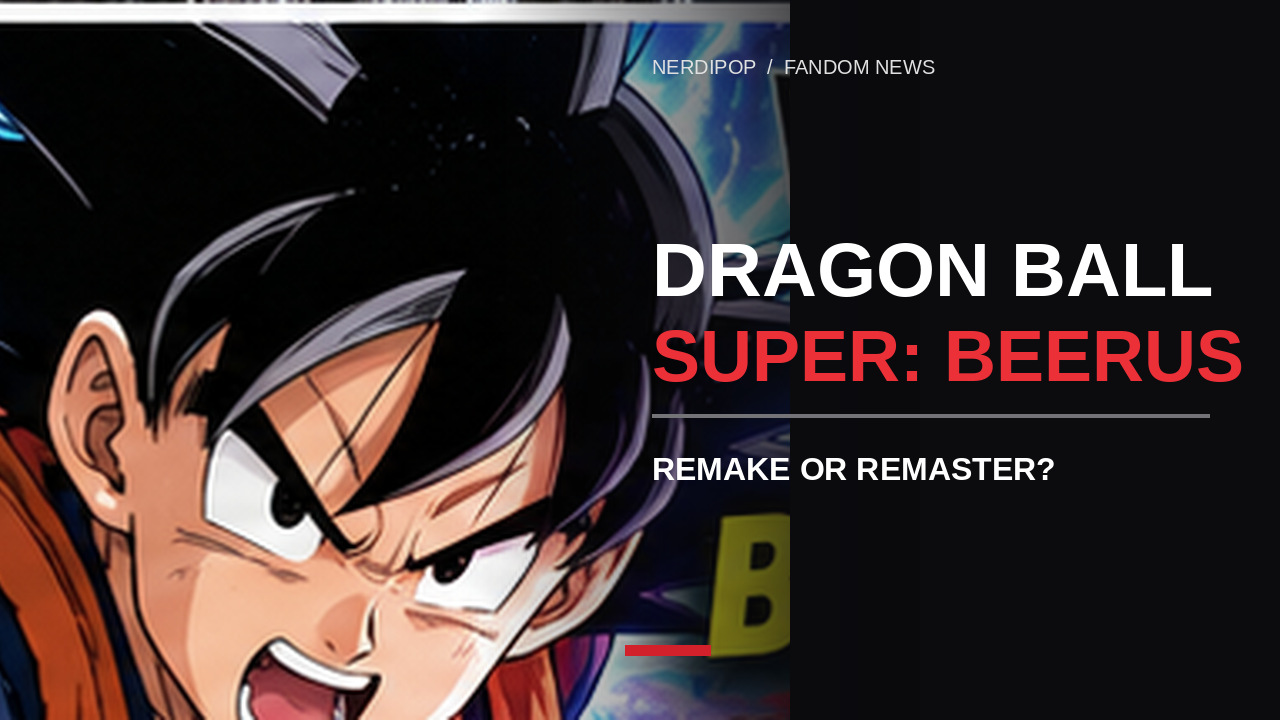
Dragon Ball Super: Beerus is back – but is this a remake, remaster or something completely different?
Few anime franchises have reinvented themselves as successfully as Dragon Ball. From Goku’s childhood adventures and the enormous battles of Dragon Ball Z to the expansion of the universe in Dragon Ball Super, Akira Toriyama’s creation has remained a defining part of Japanese popular culture for generations.
Now, one of the most important turning points in Goku’s journey is being revisited through Dragon Ball Super: Beerus, an enhanced edition of the anime that began broadcasting in Japan on 11 October 2026.
The production introduces redrawn animation, newly added scenes and changes to the narrative presentation, bringing a familiar story back to television with a revised visual identity.
However, the announcement has also created some confusion about what the new series actually represents. Is it a remake of Dragon Ball Super, a remaster of the existing episodes or an entirely new continuation?
The answer is more interesting than simply describing it as another re-release.
Why Beerus changed Dragon Ball forever
When Dragon Ball Z concluded its original television run in 1996, Goku had already faced some of the most dangerous villains in anime history.
From Frieza and Cell to Majin Buu, each major opponent pushed the series towards increasingly extraordinary transformations and levels of power.
For years, the familiar structure involved Goku and his allies facing threats that seemed impossible to overcome, only to discover new abilities through training, determination and desperate battles.
Beerus introduced a very different kind of challenge.
Rather than being another villain attempting to conquer Earth, Beerus was revealed as the God of Destruction of Universe 7, a divine figure responsible for maintaining balance through destruction.
Accompanied by his attendant and martial arts teacher Whis, Beerus arrived in search of the legendary Super Saiyan God.
His extraordinary strength immediately challenged the assumptions established by earlier Dragon Ball stories.
Even characters who had previously seemed almost unbeatable were suddenly confronted by a being operating on an entirely different level.
Beerus also possessed an unusual personality. Despite his terrifying power, he was frequently motivated by curiosity, boredom and his appreciation for delicious food.
That combination of overwhelming strength and unpredictable behaviour made him one of the franchise’s most distinctive additions.
The origins of the Battle of Gods storyline
Beerus first appeared in the 2013 theatrical film Dragon Ball Z: Battle of Gods, which marked an important return to the franchise with direct involvement from Akira Toriyama.
The film introduced Beerus, Whis and the concept of Super Saiyan God, significantly expanding the mythology of the Dragon Ball universe.
The story later became part of the opening narrative of the Dragon Ball Super television anime, which premiered in 2015.
That adaptation retold the essential events of Battle of Gods while expanding certain scenes and incorporating them into the structure of the new television series.
However, the early episodes of Dragon Ball Super received criticism from some fans because of inconsistent animation quality and comparisons with the theatrical versions of the same storylines.
The new enhanced edition provides an opportunity to revisit that material with a more consistent and updated presentation.
What exactly is Dragon Ball Super: Beerus?
According to the official Dragon Ball website, Dragon Ball Super: Beerus is an enhanced edition of the original anime rather than a completely new sequel.
The production introduces substantial additions and revisions, including redrawn animation, newly created cuts and changes to how the narrative is presented.
Its official description emphasises improved visual quality, more immersive battles and an approach intended to reflect the original manga more faithfully.
This distinguishes it from a conventional remaster.
A traditional remaster generally concentrates on improving the technical presentation of existing material, such as resolution, colour and sound quality, while leaving the underlying content largely unchanged.
An enhanced edition can go further by revising animation, introducing new footage and restructuring elements of the original production.
At the same time, Dragon Ball Super: Beerus is not being presented as a wholly new continuation of Goku’s story.
It revisits established events, particularly the arrival of Beerus and the search for the Super Saiyan God.
For viewers who already know the original anime, the main attraction is therefore the opportunity to experience a familiar storyline in a revised form.
What has changed in the animation?
The official production information highlights extensive redrawing and newly added animation cuts.
These changes are intended to improve visual consistency and provide more expressive action sequences, particularly during the major battles.
The original Dragon Ball Super television series occasionally struggled with the demands of producing large-scale action within a weekly broadcast schedule.
Although the animation improved substantially in later arcs, its early episodes became a frequent subject of discussion among fans.
An enhanced edition allows the production team to revisit sequences that may not have received the attention originally intended.
The new presentation also offers an opportunity to improve continuity between scenes and create a more consistent visual experience.
However, the effectiveness of those changes is something viewers will need to judge by comparing the finished episodes with the earlier versions.
A new musical identity
The enhanced edition also introduces new theme music, giving the revised production an identity of its own.
MEGATERA・ZERO performs the opening theme, ONOGAMI, while VK Blanka performs the ending theme, Kan Peki No Peki.
New opening and ending sequences may seem like relatively small additions, but they contribute significantly to how an anime establishes its atmosphere.
For a franchise with decades of memorable music, those choices also create opportunities to introduce a familiar storyline to younger audiences through a different musical presentation.
The new material accompanies promotional trailers and visuals highlighting the updated animation.
Why revisit Beerus instead of making a new story?
The decision to revisit the beginning of Dragon Ball Super has an interesting creative logic.
Beerus fundamentally transformed the scale of the franchise by introducing gods, divine techniques and the existence of a much larger universe.
His arrival paved the way for developments involving other universes, powerful divine beings and increasingly complex forms of martial arts.
In that sense, the Beerus storyline functions as the foundation for much of the mythology that followed.
Revisiting those events could provide a more accessible starting point for viewers who have never watched Dragon Ball Super.
It also creates an opportunity to present earlier storylines with visual standards more closely aligned with later productions.
For long-time fans, the attraction is different. They already know the major events, but may be interested in seeing how the creators reinterpret familiar battles and character interactions.
What about the future of Dragon Ball Super?
The enhanced edition arrives during a period in which the wider Dragon Ball franchise continues developing through anime, games and other projects.
One of the most anticipated announcements is Dragon Ball Super: The Galactic Patrol, a separate anime project associated with later manga material.
That production should not be confused with Dragon Ball Super: Beerus.
The enhanced edition revisits existing story material, while The Galactic Patrol is intended to bring a different part of the franchise into animation.
The distinction matters because promotional discussions sometimes refer broadly to new Dragon Ball Super anime without explaining which project is involved.
Fans should also be cautious about assuming that every remaining arc will automatically receive an enhanced adaptation. Future production plans must be established through official announcements.
Where can you watch Dragon Ball Super: Beerus?
The enhanced edition began airing in Japan on 11 October 2026.
Crunchyroll confirmed international streaming from the same date across numerous territories, including Africa, Europe, the Americas, India, Australia and parts of Asia.
For South African viewers, the announcement includes Africa among the supported regions, although individual account access, language options and episode availability should still be checked through the local Crunchyroll catalogue.
The official anime website also provides trailers, promotional visuals and production updates.
Is the enhanced edition worth watching?
For viewers who were disappointed by aspects of the original television animation, the new edition offers an opportunity to see the Beerus storyline presented with additional care.
Newcomers may appreciate a revised introduction to the characters and mythology that became central to Dragon Ball Super.
However, fans hoping for a completely unfamiliar story should understand that this is a reinterpretation of established material rather than a direct sequel.
The real question is whether the revised animation and presentation add enough to make returning to the storyline worthwhile.
Beerus remains one of the most important characters introduced during the modern era of Dragon Ball, and his arrival fundamentally changed the direction of Goku’s adventures.
Revisiting that moment is therefore more than a simple exercise in nostalgia. It is an opportunity to examine the point at which Dragon Ball expanded beyond its familiar collection of powerful warriors into a mythology involving gods, multiple universes and entirely new possibilities.
Would you rather see more classic Dragon Ball storylines receive enhanced animation, or should the franchise concentrate exclusively on completely new adventures?
Share this article
