
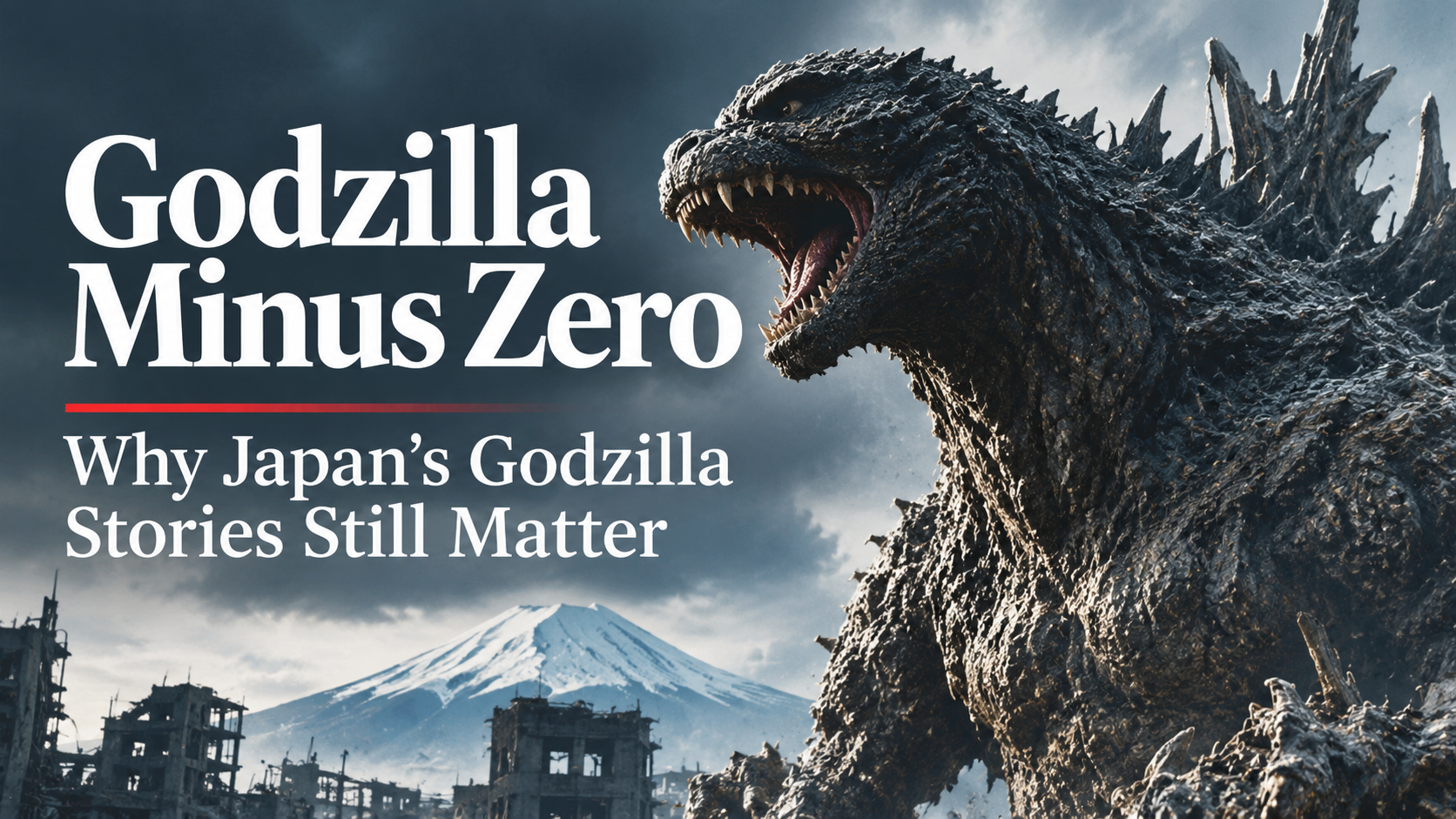
Godzilla Minus Zero: Why Japan’s Most Famous Monster Still Matters
Godzilla Minus Zero has delivered a record-breaking international opening, but its greatest achievement may be something much more meaningful than box-office success. More than seventy years after Godzilla first appeared, Japan’s most famous monster continues to tell stories about war, survival and humanity’s relationship with destruction.
When Godzilla Minus One arrived in 2023, it reminded audiences that Godzilla could be genuinely terrifying.
Not simply because of his enormous size, devastating atomic breath or ability to destroy entire cities, but because of what he represented.
Director Takashi Yamazaki returned the legendary monster to post-war Japan, creating a story that combined spectacular destruction with an emotional exploration of trauma, guilt and survival.
The result was an international success that earned the Academy Award for Best Visual Effects.
Now Yamazaki has returned with Godzilla Minus Zero, a direct follow-up that continues the story of a country struggling to recover from unimaginable devastation.
Released in Japan on 3 November and North America on 6 November 2026, the sequel opened with an estimated $31.6 million at the North American box office.
The result established a record for a live-action foreign-language opening, excluding the unusual comparison with The Passion of the Christ, which was primarily performed in Aramaic.
But the numbers only tell part of the story.
Godzilla was never just another movie monster
To understand Godzilla’s enduring appeal, we need to return to 1954.
Japan was still recovering from the Second World War and the atomic bombings of Hiroshima and Nagasaki.
When director Ishirō Honda introduced Godzilla to cinema audiences, the creature represented fears deeply connected to nuclear weapons and humanity’s capacity for destruction.
The original film was not simply about a giant monster attacking Tokyo.
It explored the terrifying consequences of forces that humanity had unleashed but could not fully control.
That historical context gave Godzilla a significance beyond the usual creature feature.
The monster became a way of exploring questions about war, responsibility, scientific progress and the vulnerability of ordinary people.
Over the decades, Godzilla’s personality has changed considerably, but his origins remain central to the character’s identity.
How Godzilla Minus One brought the franchise back to its roots
Set in Japan shortly after the Second World War, Godzilla Minus One follows Kōichi Shikishima, a former kamikaze pilot haunted by guilt and the consequences of his wartime experiences.
Shikishima returns to a devastated country where countless people are attempting to rebuild their lives.
His relationship with Noriko Ōishi and the young Akiko gradually offers the possibility of a different future.
But the arrival of Godzilla threatens to destroy that fragile hope.
The film works because its human characters matter.
Instead of relying exclusively on military battles and visual effects, Yamazaki gives the audience people whose lives have already been shaped by tragedy.
Godzilla becomes the physical embodiment of another overwhelming catastrophe.
The monster’s destruction is spectacular, but the emotional consequences are what make it frightening.
What happens in Godzilla Minus Zero?
Godzilla Minus Zero takes place two years after the events of its predecessor.
Japan has made painful progress towards recovery, and ordinary people are beginning to rebuild their lives.
But the country is still vulnerable.
The return of Godzilla creates another crisis, threatening the peace that survivors have worked so hard to achieve.
The sequel also returns to the personal consequences of the earlier film, including the unresolved effects of Godzilla’s previous attack.
The story continues to examine a familiar question: how does a society recover when the possibility of another disaster never entirely disappears?
Yamazaki returns as director, screenwriter and visual effects supervisor, providing creative continuity between the two productions.
That is especially important because the first film’s combination of human drama and large-scale spectacle established such a distinctive identity.
A new technical milestone for Japanese cinema
The sequel is also significant for its filmmaking technology.
Godzilla Minus Zero is the first Japanese production made under the Filmed For IMAX programme.
This allowed the filmmakers to design sequences specifically for the expanded IMAX presentation.
For a film featuring an enormous creature whose physical scale is central to its impact, the format offers obvious opportunities.
The monster’s size, the destruction surrounding him and the reactions of the people below become even more overwhelming on a large screen.
The investment has already produced impressive results.
IMAX reported that Godzilla Minus Zero earned approximately $21.3 million globally from IMAX screenings during its opening period, establishing the biggest worldwide IMAX debut for a Japanese film at that point.
That result demonstrates how strongly audiences are responding to the opportunity to experience Japanese Godzilla storytelling on a cinematic scale.
Japan’s Godzilla versus Hollywood’s MonsterVerse
One of the most interesting aspects of the modern Godzilla franchise is that the Japanese and Hollywood productions offer very different interpretations of the same character.
Hollywood’s MonsterVerse, including Godzilla vs. Kong and Godzilla x Kong: The New Empire, increasingly presents Godzilla as one of several enormous creatures competing for dominance.
These films celebrate the excitement of giant monster battles.
They introduce elaborate fictional ecosystems, ancient rivalries and spectacular encounters between creatures that would otherwise be impossible.
Japan’s recent Godzilla films often take a different approach.
In Shin Godzilla, the monster becomes a terrifying crisis that challenges government institutions and emergency responses.
In Godzilla Minus One, he represents destruction confronting an already traumatised society.
Both approaches can be entertaining.
But the Japanese films frequently place greater emphasis on what Godzilla means to the people living in his shadow.
Why human characters make monster films better
Spectacular destruction can capture an audience’s attention, but it cannot sustain emotional investment on its own.
A collapsing building becomes more meaningful when we know the people inside.
A city under attack becomes more frightening when viewers understand what its residents stand to lose.
This is where Godzilla Minus One succeeded so effectively.
Shikishima’s personal journey gave the audience an emotional reason to care about the outcome.
His struggle wasn’t simply about defeating a monster.
It was about finding a reason to continue living after tremendous loss.
Godzilla Minus Zero has the opportunity to develop those themes further while introducing a new threat.
A monster that has survived more than seventy years
Godzilla has changed dramatically since 1954.
At different points, he has been a terrifying villain, an unwilling defender of humanity, a symbol of environmental destruction and the central figure in elaborate battles against other monsters.
He has appeared in serious dramas, children’s entertainment, animation, comics and video games.
Yet the character remains recognisable.
His iconic roar, distinctive silhouette and enormous presence have become part of international popular culture.
What keeps him relevant is not merely nostalgia.
It’s the freedom filmmakers have to reinterpret what he represents for each generation.
Why Godzilla Minus Zero matters
The success of Godzilla Minus Zero demonstrates that audiences still have an appetite for Japanese stories about the King of the Monsters.
The film’s impressive opening is important, particularly for a Japanese-language production competing in an international market.
But the franchise’s lasting strength lies in something deeper.
Godzilla can be a source of cinematic excitement while also representing humanity’s fears about war, technology and uncontrollable destruction.
Few fictional monsters have managed to maintain that combination for so long.
And as long as filmmakers continue to find meaningful stories beneath the spectacle, Godzilla will remain much more than a giant creature emerging from the sea.
Which Godzilla do you prefer: Japan’s terrifying force of destruction or Hollywood’s larger-than-life MonsterVerse hero?
Share this article
