
Disney Is Returning to Sleeping Beauty But This Is Not the Remake You Might Expect
Disney is going back to one of the most visually distinctive films in its entire animation history.
A new movie inspired by Sleeping Beauty is in early development at Disney, with Dan Trachtenberg, the filmmaker behind Prey and 10 Cloverfield Lane, attached to direct. But before anyone starts picturing another shot-for-shot live-action recreation of Princess Aurora wandering through the forest singing “Once Upon a Dream”, this project appears to be taking a very different approach.
According to the initial industry reports, the currently untitled film is based on an original idea inspired by Disney’s Sleeping Beauty and is expected to take the material in an entirely new direction. Plot details are being kept secret. That distinction could be very important.
Who is making the new Sleeping Beauty movie?
Trachtenberg developed the story with Rayna McClendon. Alex Anfanger and Dan Schimpf, who created the Comedy Central series Big Time in Hollywood, FL, are writing the screenplay. Trachtenberg is also producing alongside his longtime producing partner Ben Rosenblatt and Star Wars producer Michelle Rejwan. Disney executives Jessica Virtue and Alina Mota are overseeing the project under Disney Live Action.
As of September 2026, the production remains in early development. There is no announced title, cast, production start date or release date. So any supposed Aurora, Phillip or Maleficent casting currently circulating online should not be treated as confirmed.
And this is not Maleficent 3
This is probably the biggest source of confusion around the announcement. The new project has no connection to the Maleficent films starring Angelina Jolie. Disney already revisited Sleeping Beauty in live action through Maleficent in 2014, which retold the familiar story largely from Maleficent’s perspective, with Angelina Jolie as Maleficent and Elle Fanning as Aurora.
That was followed by Maleficent: Mistress of Evil in 2019, which continued the relationship between Maleficent and Aurora rather than retelling the original animated film again. Trachtenberg’s movie is separate from those films.
That leaves a very interesting question: What exactly does “inspired by Sleeping Beauty” mean?
Disney isn’t saying yet. And until it does, anything more would be speculation.
The 1959 Sleeping Beauty is a particularly difficult Disney film to revisit
This is where the story becomes much more interesting than simply reporting that Disney is returning to another animated classic. Sleeping Beauty was released in 1959, but Disney had been working towards it for much of the decade. Walt Disney registered Sleeping Beauty as a planned production title in January 1950 and envisioned it as something approaching the ultimate expression of Disney animation.
The basic story is familiar. Princess Aurora is cursed by Maleficent as a baby. Before the sun sets on her sixteenth birthday, she will prick her finger on the spindle of a spinning wheel and die. The good fairy Merryweather cannot undo Maleficent’s curse, but she alters it. Aurora will instead fall into an enchanted sleep from which true love’s kiss can awaken her.
Flora, Fauna and Merryweather hide Aurora in the forest and raise her as Briar Rose. She eventually meets Prince Phillip without knowing that he is the prince to whom she was betrothed as a baby. The curse is fulfilled, Phillip battles Maleficent after she transforms into a dragon and Aurora eventually awakens. Simple enough.
Visually, however, Sleeping Beauty was anything but simple.
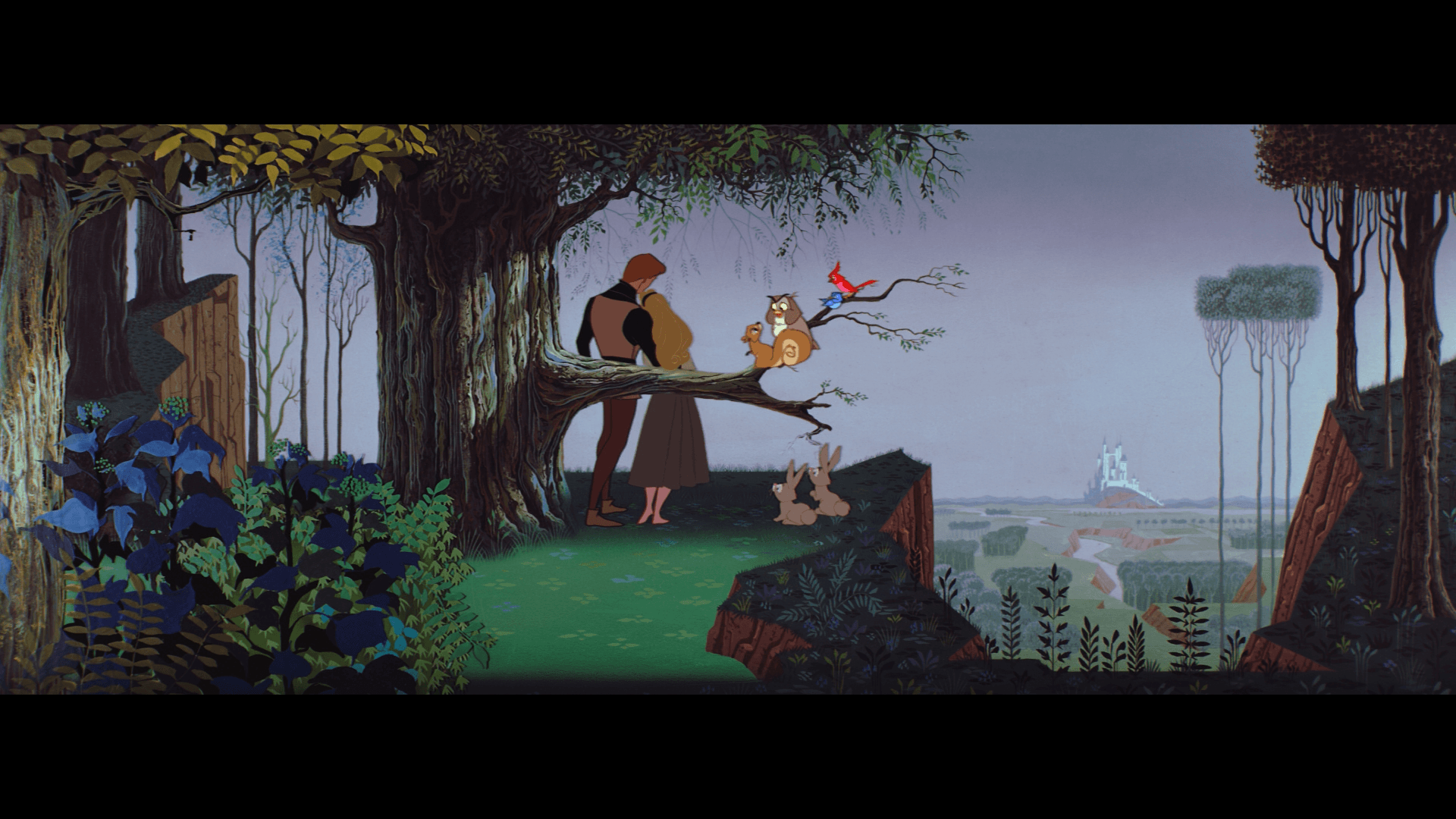
Eyvind Earle made Sleeping Beauty look unlike almost any other Disney film
The film’s extraordinary appearance came largely from artist Eyvind Earle, who was responsible for its overall production design, styling, backgrounds and colour. Walt Disney wanted the film to look different from the softer, rounder visual approach associated with earlier films such as Snow White and the Seven Dwarfs and Cinderella.
Earle instead created a highly stylised world influenced by medieval art, Gothic design and Renaissance painting. Some of the backgrounds were reportedly 15 feet long, while the characters themselves had to be redesigned so they would actually belong inside Earle’s angular, highly controlled landscapes.
Disney described the ambition as creating something closer to a moving illustration. The painstaking production meant that more than 300 artists and technicians were involved. A single cleaned-up drawing of Briar Rose could reportedly take an entire day to complete.
That is a large part of why the film still looks so unusual nearly seven decades later.
It was enormously expensive
Sleeping Beauty cost more than $6 million, making it Walt Disney’s most expensive animated feature at the time. It was also created for Technirama 70, allowing those elaborate landscapes to fill an unusually wide cinema screen. The film’s score drew heavily from Pyotr Ilyich Tchaikovsky’s Sleeping Beauty ballet, with George Bruns adapting themes from the ballet for Disney’s soundtrack.
Even the song most closely associated with the film, “Once Upon a Dream”, uses music derived from Tchaikovsky’s ballet.
And it wasn’t initially the triumph Disney expected
Today Sleeping Beauty is regarded as one of Disney’s classic animated films. That was not necessarily how its original theatrical run looked. Despite the scale and expense of the production, the film was not an immediate box-office success. Subsequent theatrical reissues helped establish its reputation over time. In other words, Sleeping Beauty became more beloved with age.
That makes its current position within Disney culture particularly fascinating. Aurora is one of the company’s most recognisable princesses. Maleficent became one of its definitive villains. Sleeping Beauty Castle became part of Disney park iconography.
Yet the original film itself was once considered an enormously expensive risk.
Aurora is barely in her own movie
There is another fact that becomes important when discussing a modern reinvention. Despite being the title character, Aurora has surprisingly little screen time. She appears for fewer than 18 minutes.
She also spends a significant portion of the final act asleep. The 1959 movie consequently gives enormous narrative importance to Flora, Fauna and Merryweather, Prince Phillip and, especially, Maleficent. That helped create one of the most memorable villains in Disney history, but it also leaves plenty of space for a new adaptation to approach the basic material from another direction.
Again, Disney has not said that this is what Trachtenberg’s film will do. But it helps explain why Sleeping Beauty contains far more material to reinterpret than the phrase “live-action remake” might suggest.
Why Dan Trachtenberg makes this announcement particularly unusual
Trachtenberg is not an obvious choice for a Disney princess project. And that is precisely why the announcement has attracted attention. His feature directing breakthrough was the claustrophobic science-fiction thriller 10 Cloverfield Lane. More recently he became closely associated with the Predator franchise through Prey, followed by further work in that universe. The reporting around Disney’s new Sleeping Beauty project says the film will take the material in a new direction shaped by Trachtenberg’s filmmaking sensibility.
What that direction actually is remains completely unknown. It would therefore be premature to declare that Disney is making a dark Sleeping Beauty, an action movie, a horror version or anything else based simply on the director’s previous work.
The only confirmed description so far is an original idea inspired by Sleeping Beauty.
So is Disney actually remaking Sleeping Beauty?
At the moment, not in the conventional sense. Disney’s Beauty and the Beast, Aladdin, The Little Mermaid and Snow White all took recognisable structures, characters and imagery from their animated predecessors and recreated them as new feature films.
The wording around this project is noticeably different. It is not currently being called Sleeping Beauty. It is not being described as a direct remake. And it is explicitly being positioned as an original idea inspired by the classic story. That may change as development progresses, but right now the safest description is: Disney is developing a new film inspired by its Sleeping Beauty property, directed by Dan Trachtenberg, which will be separate from the Angelina Jolie Maleficent films and will take the material in a new direction.
Everything beyond that remains behind the castle walls.
Why this one is worth watching
The most interesting part of this project may not be that Disney is returning to Sleeping Beauty. It is how difficult the original film is to reproduce. The 1959 movie is remembered as much for Eyvind Earle’s extraordinary visual design, Tchaikovsky-inspired music, Technirama presentation and Maleficent’s unforgettable presence as it is for Aurora herself. It was enormously ambitious, hugely expensive and initially far less successful than its reputation today might suggest. Now the filmmaker behind Prey has been handed that world and apparently told not simply to remake it, but to find another way into it. There is no cast or release date yet.
There is not even an official title. But if Disney really intends to move beyond another direct recreation of one of its animated classics, this may be one of its more interesting live-action projects to watch.
Share this article
