
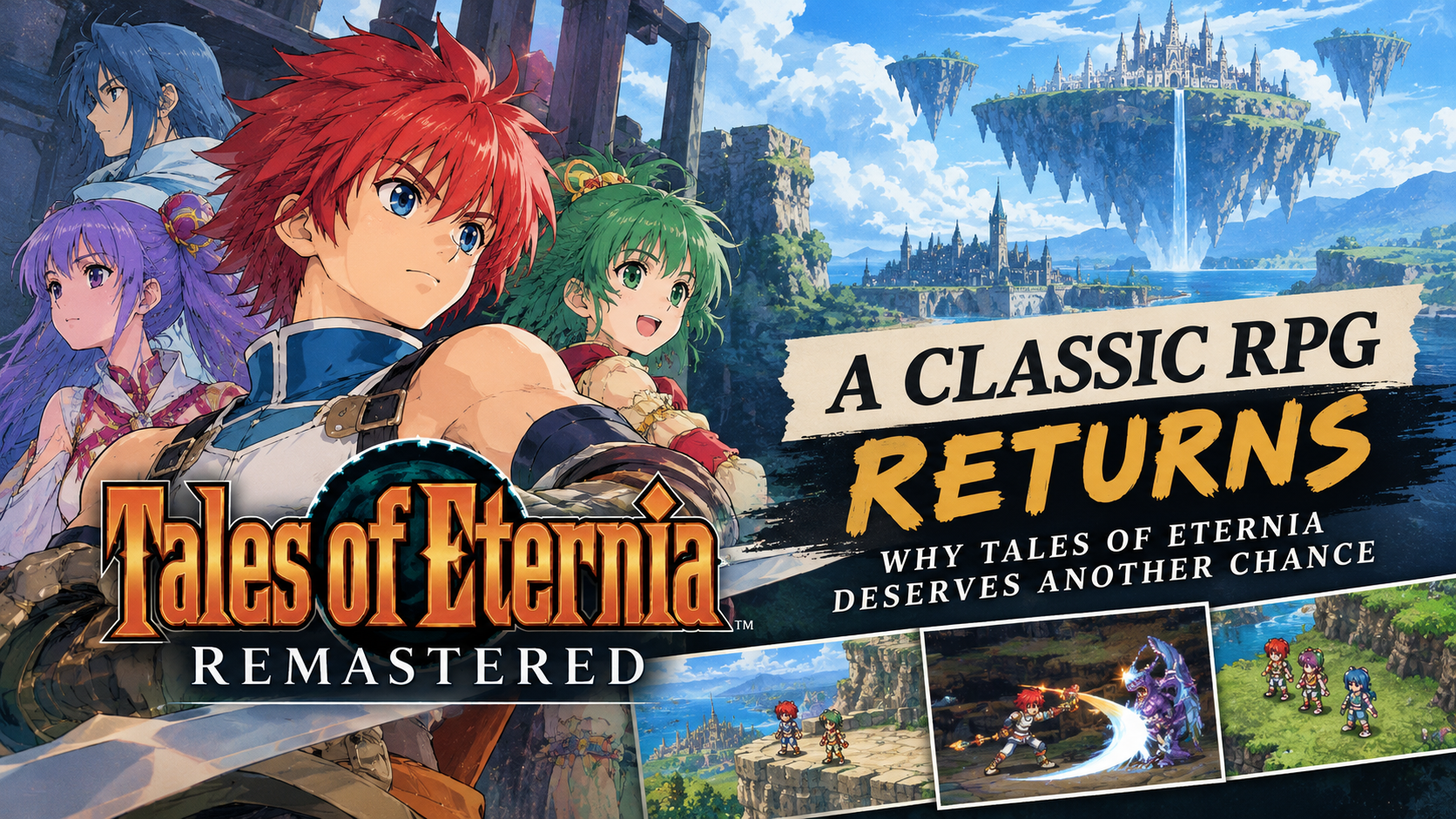
Tales of Eternia returns – why this classic fantasy RPG deserves another chance
The early 2000s were an exciting period for Japanese role-playing games. Developers were experimenting with combat systems, increasingly elaborate fantasy worlds and character-driven stories, creating adventures that would remain memorable long after their original consoles disappeared from living rooms. For many players, these games represented a particularly imaginative period in gaming history.
Tales of Eternia belongs to that generation. Originally released in Japan in 2000 and in North America in 2001 under the title Tales of Destiny II, the game became one of the early entries in Namco’s long-running Tales franchise. Its combination of colourful characters, real-time combat and an ambitious fantasy storyline helped establish an identity that continues to influence the series.
Now, more than 25 years after its original debut, Tales of Eternia Remastered is returning the adventure to modern gaming platforms. The remaster reached its 15–16 October 2026 launch window, introducing updated presentation options and convenience features while retaining the foundations of the original game.
For established fans, the release offers a chance to revisit a familiar world. For players who discovered the franchise through more recent entries, it provides an opportunity to experience an important part of Japanese RPG history.
Two worlds on the brink of destruction
Tales of Eternia takes place in a fantasy universe divided between two worlds, Inferia and Celestia. Its story begins in the Inferian village of Rasheans, where Reid Hershel and his childhood friend Farah Oersted encounter a mysterious girl named Meredy.
Her unexpected arrival sets an extraordinary journey in motion. As Reid and his companions learn more about Meredy and her origins, they discover that the two worlds face a catastrophic event known as the Grand Fall. Unless the disaster can be prevented, Inferia and Celestia could collide, threatening the existence of both.
The group must travel through unfamiliar lands, encounter different cultures and investigate the powers of elemental spirits known as Greater Craymels. What begins as an unusual encounter gradually develops into a much larger adventure involving the relationship between two worlds and the forces threatening their survival.
Although the premise contains familiar fantasy elements, the game also explores communication, friendship and the difficulties that arise when people from different backgrounds struggle to understand one another. These themes are reinforced by the characters themselves, whose conflicting personalities become an important part of the adventure.
The characters are at the heart of the story
Reid Hershel is not a conventional hero eager to embark on a dangerous quest. He would rather enjoy a peaceful life than become involved in events that threaten the world, making his reluctance an important part of his character.
Farah, by contrast, is energetic, determined and often motivated by a desire to help others. Her enthusiasm regularly pushes Reid beyond his comfort zone, creating a dynamic that combines humour with genuine affection.
Keele Zeibel contributes a more analytical perspective, while Meredy’s mysterious origins and unusual circumstances provide much of the story’s initial intrigue. Their differing personalities create tension, misunderstandings and opportunities for emotional development as the journey progresses.
This emphasis on relationships became one of the distinguishing features of the Tales franchise. Rather than functioning simply as a group of characters assigned to different combat roles, party members develop through their shared experiences and interactions.
For players who value character-driven storytelling, this remains one of the most appealing aspects of classic Japanese RPGs. Their worlds may be filled with magical creatures and extraordinary threats, but the emotional journey is frequently grounded in the friendships formed along the way.
A combat system that helped distinguish the Tales franchise
One of Tales of Eternia‘s most notable features is its real-time battle system. While many Japanese RPGs of the period used turn-based combat, Eternia developed the series’ action-oriented approach through the Aggressive Linear Motion Battle System.
Characters fight within a two-dimensional battlefield, moving and attacking in real time while performing special techniques and combining abilities. The result is a combat style that feels closer to an action game than the traditional menu-driven encounters associated with many earlier RPGs.
This approach helped distinguish the Tales franchise from other major Japanese role-playing series. Instead of relying exclusively on selecting commands and waiting for turns, players could experience a more immediate connection to the battles.
Although later Tales games would expand and transform the combat system considerably, Eternia remains an interesting example of the franchise’s earlier design philosophy.
What is different in Tales of Eternia Remastered?
Bandai Namco has introduced several features intended to make the original game more accessible to contemporary players without completely replacing its identity.
The remaster allows players to choose between the original and enhanced graphical presentation, as well as between classic and updated sound effects. These options are particularly useful for players who want to experience the game as they remember it while benefiting from improved compatibility with modern systems.
Several gameplay conveniences have also been added. Players can adjust experience gains and encounter frequency, allowing them greater control over how quickly their characters develop and how frequently battles interrupt exploration.
Additional features include destination markers, battle retries, quick recovery and faster auto-battle functionality. Extreme difficulty is available from the beginning, while the new Unknown difficulty can be unlocked after completing the game.
These additions reflect a growing recognition that preserving a classic game does not necessarily mean preserving every inconvenience associated with its original release.
Why classic RPGs deserve preservation
For years, one of the greatest difficulties facing fans of older Japanese RPGs has been accessibility. Many titles were released on consoles that are no longer manufactured, while physical copies can become rare and expensive.
Even when players manage to obtain the original hardware, compatibility with modern displays and the availability of replacement components can create additional problems.
Remasters provide publishers with an opportunity to make important games available to new audiences without requiring them to invest in ageing hardware. They can also introduce modern conveniences that make older designs more approachable, particularly for players accustomed to contemporary RPG systems.
This matters because gaming history is more than a collection of famous titles. It is a record of experimentation, changing technology and creative ideas that helped shape the games people enjoy today.
Revisiting Tales of Eternia allows players to appreciate how Japanese developers approached storytelling, combat and character relationships during an earlier period of the medium’s development.
Should you play Tales of Eternia in 2026?
Whether the remaster appeals to you will depend partly on your expectations. Players looking for a completely modernised remake with extensive changes to the original design may find the experience more traditional than they anticipated.
Its structure, presentation and storytelling reflect the era in which it was created, even with the improvements introduced by Bandai Namco.
However, that is also part of its appeal. Tales of Eternia offers a fantasy adventure built around a relatively focused narrative, a distinctive cast and an engaging combat system that helped establish the identity of a long-running franchise.
For experienced fans, returning to Inferia and Celestia may be an enjoyable reminder of the adventures that first attracted them to Japanese RPGs. For newcomers, the remaster provides a chance to discover a classic without the difficulties associated with finding and maintaining original hardware.
Not every beloved game needs to be completely reinvented to remain worthwhile. Sometimes an older title simply needs to become accessible again, giving a new generation the chance to understand why players remember it so fondly.
Which classic RPG deserves a modern return: Chrono Trigger, Legend of Dragoon, Golden Sun or another forgotten favourite?
Share this article
