
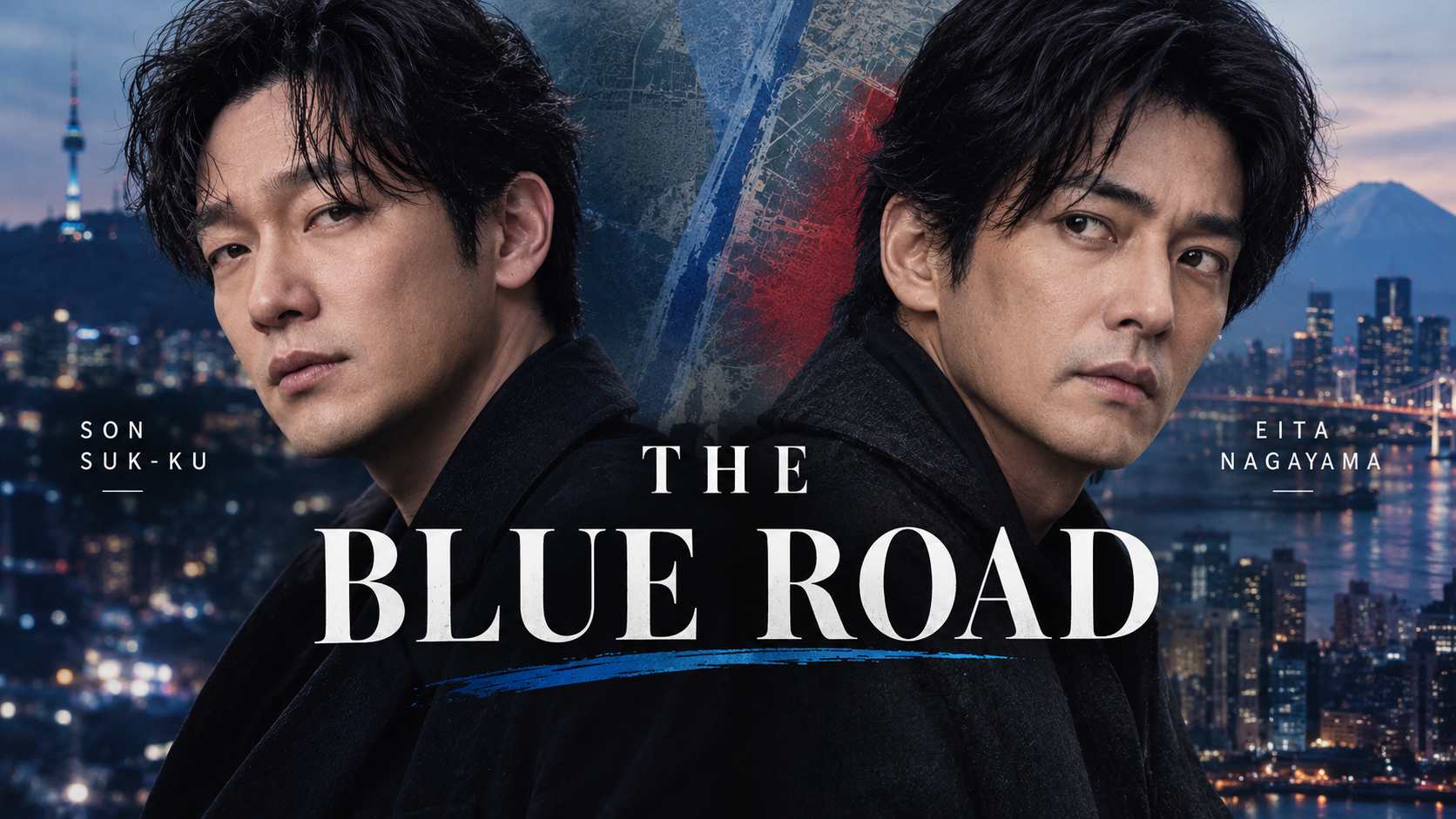
The Blue Road – why Korean and Japanese crime thrillers are finding common ground
Asian crime dramas have developed a reputation for gripping mysteries, morally complicated characters and stories that rarely offer easy answers.
Now, The Blue Road, a reported Korean–Japanese crime thriller involving Son Suk-ku and Eita Nagayama, is drawing attention to the growing opportunities for collaboration between the two entertainment industries.
Early coverage describes the project as a cross-border production based on comic-book source material, with a reported November 2026 Netflix release following attention surrounding the Busan International Film Festival.
However, the precise release arrangements, production credits and source material still require independent confirmation. Until those details are established, the project is best viewed as a promising upcoming title rather than a fully verified release announcement.


Why Korean and Japanese crime stories make an interesting combination
Although Korean and Japanese entertainment industries frequently explore similar genres, their approaches to crime storytelling can be quite different.
Korean crime thrillers often combine intense emotional conflict with wider questions about corruption, institutional power and social inequality.
Productions such as Signal, Stranger and Beyond Evil have demonstrated how crime investigations can become complex examinations of justice, guilt and personal responsibility.
Japanese crime dramas frequently place particular emphasis on psychological tension, procedural detail and the consequences of decisions made within tightly structured social environments.
These are broad tendencies rather than fixed rules, but they help explain why collaboration between the two industries can produce interesting creative possibilities.
A story involving characters from both countries can explore different legal systems, cultural expectations and investigative approaches.
It can also introduce audiences to actors and storytelling traditions they might not otherwise encounter.
Son Suk-ku’s appeal in darker roles
Son Suk-ku has become particularly recognisable for performances that balance charm, unpredictability and emotional complexity.
In My Liberation Notes, his portrayal of the mysterious Mr Gu helped make the character one of the drama’s most memorable figures.
In A Killer Paradox, he played a determined detective investigating a series of unusual deaths.
His performance in The Roundup also demonstrated his ability to portray a genuinely threatening antagonist.
That range makes him an interesting actor for crime stories where characters cannot easily be divided into heroes and villains.
He can suggest considerable internal conflict without needing to explain everything through dialogue.
What Eita Nagayama brings to the project
Eita Nagayama has built a varied career in Japanese film and television, appearing in dramas, comedies and more psychologically demanding roles.
His performances frequently balance understated emotion with complicated character relationships.
Pairing performers with different acting backgrounds and screen traditions could create an interesting dynamic, particularly in a story involving mistrust, investigation or conflicting motivations.
Of course, the effectiveness of that pairing will depend on the screenplay and the characters they are given.
The growing appeal of cross-border Asian productions
International streaming has made it easier for audiences to discover entertainment outside their own countries.
Korean dramas have reached enormous global audiences, while Japanese films, anime and television series continue to attract international interest.
Collaborations between the industries can potentially benefit from that shared audience.
They also provide opportunities to develop stories that move naturally between different cultural settings.
But international casting alone does not guarantee a compelling production.
The strongest collaborations are those in which the involvement of multiple countries contributes meaningfully to the story.
For a crime thriller, that could mean exploring jurisdictional complications, cultural misunderstandings or characters whose personal histories cross national boundaries.
What should viewers expect?
Until the full production details and international release information are confirmed, it would be premature to make detailed claims about The Blue Road’s storyline or reception.
What makes the reported project interesting is the wider creative opportunity it represents.
Korean and Japanese entertainment have both produced exceptional crime dramas.
A well-developed collaboration could bring together their strengths while introducing viewers to a distinctive new story.
And for fans of Son Suk-ku, the possibility of another complex crime role is certainly worth following.
Would you like to see more Korean–Japanese crime thrillers, and which actors from the two countries would you most like to see working together?
Editorial status: The reported production and Netflix release details have not been independently verified. Hold publication until a primary production or distributor announcement is available.
Share this article
