
The Lunar Chronicles: An In-Depth Exploration of Marissa Meyer’s Dystopian Fairy Tale Retellings
Introduction
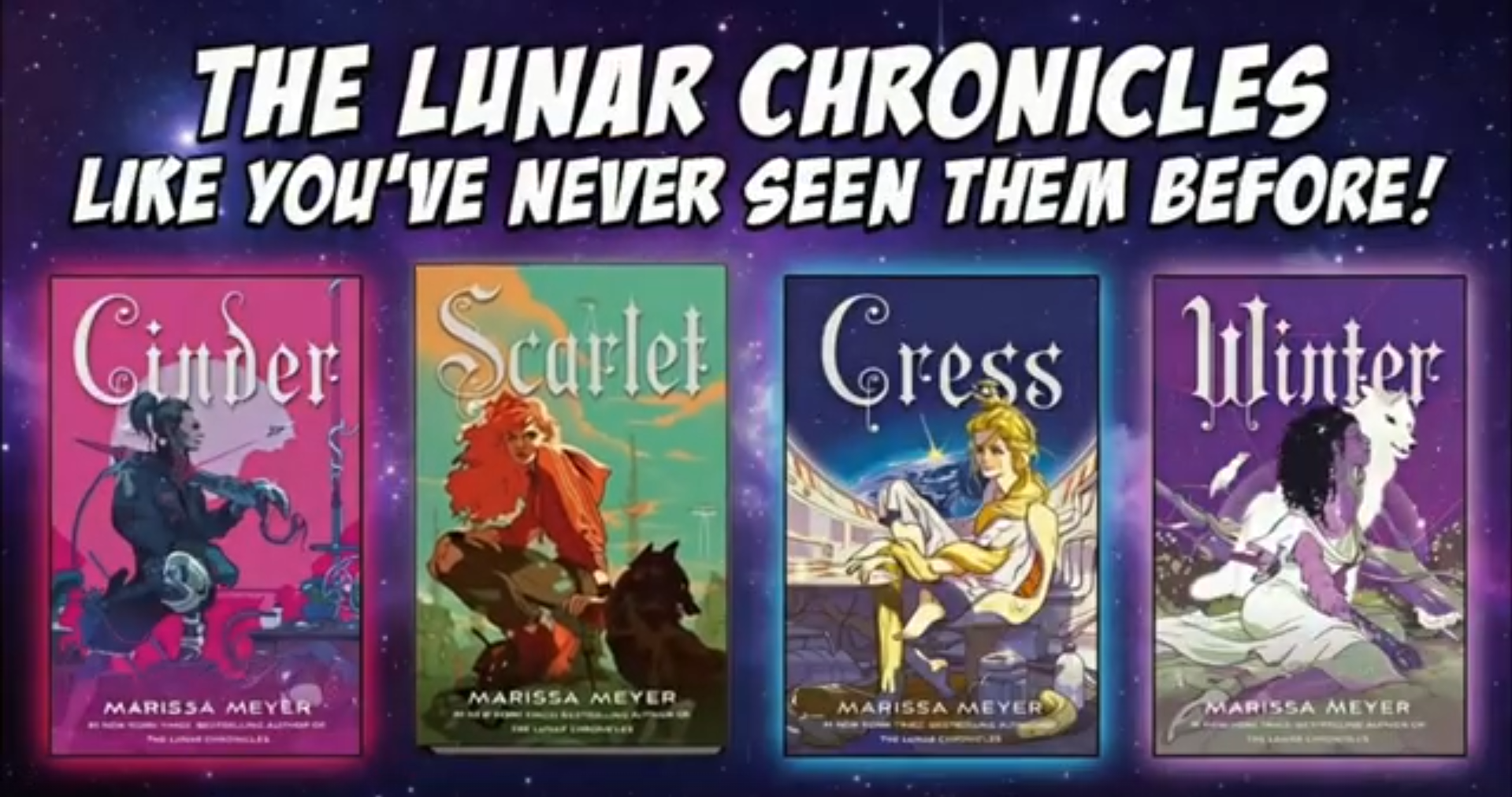
Marissa Meyer’s The Lunar Chronicles is a bestselling young adult science-fiction series that reimagines classic fairy tales in a futuristic world of cyborgs, androids, political conflict, plague, and rebellion. The main sequence includes Cinder, Scarlet, Cress, and Winter, with Fairest serving as a prequel focused on Queen Levana and Stars Above collecting short stories connected to the series. The wider universe also includes the graphic novel duology Wires and Nerve, which follows Iko after the events of the main novels.
Blending Cinderella, Little Red Riding Hood, Rapunzel, and Snow White with dystopian science fiction, Meyer creates a story about identity, power, resistance, friendship, and choosing one’s own future.
Origins and Inspiration
The Genesis of the Series
Meyer’s inspiration for The Lunar Chronicles came from her love of fairy tales and her interest in science fiction. Instead of retelling familiar stories in traditional magical kingdoms, she imagined them in a technologically advanced future where Earth faces political instability, disease, and the threat of Luna, a powerful moon colony.
Cinder, the first novel, began as a futuristic twist on Cinderella. Meyer’s use of NaNoWriMo helped shape the early drafts of the series, but the published books became much more ambitious than a simple set of retellings. Each novel adds a new fairy-tale heroine while continuing one larger, connected storyline.
Fairy Tales Reimagined Through Science Fiction
The series stands out because it does not merely copy fairy-tale plots. Instead, Meyer transforms familiar elements into futuristic equivalents. Cinderella becomes a cyborg mechanic. Little Red Riding Hood becomes a determined farm girl searching for her missing grandmother. Rapunzel becomes a hacker trapped in a satellite. Snow White becomes a Lunar princess resisting a cruel queen.
This combination allows the books to explore classic fairy-tale ideas—hidden identity, transformation, love, betrayal, and justice—through modern concerns such as technology, bodily autonomy, prejudice, surveillance, political manipulation, and revolution.
Plot Summaries
Cinder
Overview
Cinder introduces Linh Cinder, a gifted mechanic and cyborg living in New Beijing in the Eastern Commonwealth. As a cyborg, she is treated as less than fully human by much of society, including her stepmother. Her life changes when Prince Kai asks her to repair an android that may contain information vital to Earth’s survival.
At the same time, Earth is suffering from letumosis, a deadly plague, while Queen Levana of Luna pressures Prince Kai into a political marriage that could give her control over Earth.
Key Plot Points
Cinder struggles with discrimination, family cruelty, and the limits placed on her because of her cyborg status. After her stepsister Peony contracts letumosis, Cinder is forced into plague research, where she learns that her body and past are far more mysterious than she believed.
The novel builds toward the royal ball, where Cinder’s hidden identity begins to surface. By the end, she discovers that she is not simply a mechanic or an outcast, but someone central to the future of both Earth and Luna.
Scarlet
Overview
Scarlet expands the world of the series by introducing Scarlet Benoit, a French farm girl searching for her missing grandmother. Her journey brings her into contact with Wolf, a dangerous but conflicted street fighter with ties to Lunar forces.
Meanwhile, Cinder escapes prison with Captain Carswell Thorne and begins searching for answers about her past and her connection to Princess Selene, the lost Lunar heir.
Key Plot Points
Scarlet’s search reveals that her grandmother was involved in secrets connected to Cinder’s survival. Wolf’s divided loyalties create tension as Scarlet learns more about Lunar soldiers and Queen Levana’s plans.
The novel is important because it brings separate storylines together. Scarlet, Wolf, Cinder, and Thorne become part of the same larger resistance against Levana.
Cress
Overview
Cress retells Rapunzel through Crescent Moon, known as Cress, a brilliant hacker trapped alone in a satellite. She has been forced to work for Queen Levana by monitoring Earth and hiding Lunar ships from detection.
Cress has spent years dreaming of escape, romance, and heroism. When Cinder’s crew attempts to rescue her, the mission goes wrong, scattering the characters and forcing them to survive in separate groups.
Key Plot Points
Cress’s rescue leads to danger, separation, and major character development. Her relationship with Thorne grows as they survive together, while Cinder becomes more confident in her role as a leader.
The novel also raises the stakes politically. Levana’s planned marriage to Kai threatens to place Earth under Lunar control, making Cinder’s rebellion more urgent.
Winter
Overview
Winter concludes the main series and retells Snow White through Princess Winter, Queen Levana’s stepdaughter. Winter is loved by the Lunar people for her kindness, but she suffers because she refuses to use her Lunar gift to manipulate others.
As Cinder and her allies arrive on Luna, the story becomes a full-scale revolution against Levana’s rule.
Key Plot Points
Winter’s compassion contrasts sharply with Levana’s cruelty. Her bond with Jacin, her guard and childhood friend, gives her strength even as she faces danger inside the palace.
Cinder fully embraces her identity and leads a rebellion to overthrow Levana. The final book brings together the major characters—Cinder, Kai, Scarlet, Wolf, Cress, Thorne, Winter, Jacin, and Iko—for a climactic struggle over the future of Luna and Earth.
Fairest
Overview
Fairest is a prequel that focuses on Queen Levana. Rather than excusing her actions, the book explains the pain, insecurity, jealousy, and ambition that shaped her.
Key Plot Points
The novel explores Levana’s childhood, her relationship with her cruel sister Channary, and her growing dependence on glamour to control how others see her. It also shows how her desire for love and power becomes destructive.
Fairest adds depth to Levana by showing how she became the villain of the main series while still making clear that her choices cause real harm.
Stars Above and Wires and Nerve
Stars Above expands the series through short stories that reveal additional backstory and aftermath for major characters. Wires and Nerve, a graphic novel duology, continues the universe after the main novels and places Iko at the center of the action.
These companion works are especially valuable for readers who want more closure, character moments, and worldbuilding beyond the four main novels.
Characters
Linh Cinder
Cinder is the central protagonist of the series. As a cyborg mechanic, she begins the story as someone treated as property rather than as a full person. Her journey is about self-discovery, courage, and learning to lead.
Cinder’s arc is powerful because she does not become important by becoming “perfect.” She becomes important by accepting every part of herself, including the parts society has taught her to hide.
Scarlet Benoit
Scarlet is brave, emotional, stubborn, and fiercely loyal. Her search for her grandmother drives the second novel, but her importance goes beyond that quest. She represents family loyalty, moral courage, and the refusal to stay quiet when something is wrong.
Crescent Moon / Cress
Cress is imaginative, intelligent, and deeply lonely when readers first meet her. Her isolation has made her idealistic, but she is also extremely capable. Her hacking skills are essential to the rebellion.
Her arc focuses on freedom, confidence, and learning that real heroism is more complicated than the stories she has imagined.
Princess Winter
Winter is gentle, compassionate, and morally strong. Her refusal to use her Lunar gift makes her vulnerable, but it also shows her integrity. She chooses honesty over power, even when that choice costs her.
Winter’s story adds emotional depth to the final book because she shows resistance through kindness rather than force.
Prince Kai
Kai is a young ruler forced into impossible political decisions. His relationship with Cinder is central, but his role is also political. He must balance duty, fear, diplomacy, and personal loyalty while trying to protect Earth from Levana.
Carswell Thorne
Thorne begins as a charming criminal and comic relief figure, but he grows into a loyal and courageous member of Cinder’s crew. His relationship with Cress helps reveal his better qualities, though his development is also about becoming worthy of the trust others place in him.
Wolf / Ze’ev Kesley
Wolf is a genetically modified Lunar soldier who struggles with violence, loyalty, and identity. His relationship with Scarlet gives him a reason to fight against the role he was forced into.
Queen Levana
Levana is the main antagonist of the series. She uses glamour, fear, and political manipulation to maintain power. Her backstory in Fairest makes her more complex, but she remains a warning about what happens when insecurity and ambition become cruelty.
Iko
Iko is one of the most beloved characters in the series. As an android with a lively personality and strong emotional intelligence, she challenges the boundary between human and machine. Her loyalty, humor, and bravery make her essential to Cinder’s journey and to the wider rebellion.
Major Themes
Identity and Self-Acceptance
Identity is one of the strongest themes in The Lunar Chronicles. Cinder must accept her cyborg body, her Lunar heritage, and her role as Princess Selene. Cress must become more than the helpless damsel she imagines herself to be. Winter must hold onto her values in a society built on manipulation.
The series repeatedly asks what makes a person valuable: appearance, power, biology, status, or choices. Meyer’s answer is clear—character matters more than labels.
Resistance Against Tyranny
The conflict with Queen Levana turns the series into a story of rebellion. Cinder and her allies fight not only for themselves, but for people who have been controlled, deceived, or silenced.
The rebellion is not portrayed as easy. Characters face fear, betrayal, loss, and uncertainty. Still, the series presents resistance as necessary when leadership becomes abusive and corrupt.
Technology and Humanity
Cinder’s cyborg identity allows the series to explore prejudice and the definition of humanity. Many people view cyborgs as less human, but Cinder’s compassion, intelligence, and bravery challenge that belief.
The books also use androids, spaceships, surveillance systems, medical research, and bioengineering to examine how technology can be used either to help people or control them.
Love, Loyalty, and Sacrifice
Romance is important in the series, but Meyer also emphasizes friendship, found family, and loyalty. The characters repeatedly risk themselves for one another.
The romances—Cinder and Kai, Scarlet and Wolf, Cress and Thorne, Winter and Jacin—work best because they are connected to trust, choice, and shared struggle rather than instant fairy-tale perfection.
Power and Corruption
Levana’s rule shows how dangerous power becomes when it is built on fear and deception. Her glamour symbolizes political manipulation: she controls not only what people do, but what they believe they see.
In contrast, Cinder’s leadership is based on truth, cooperation, and the willingness to share power.
Cultural Impact and Reception
Popularity and Place in YA Literature
The Lunar Chronicles has remained a major series in young adult science fiction and fairy-tale retellings. Its appeal comes from its fast-paced plotting, large ensemble cast, romantic tension, and unusual blend of fantasy motifs with futuristic worldbuilding.
The series is often recommended to readers who enjoy retellings but want something more action-driven and science-fictional than traditional fantasy.
Fandom and Fan Works
The series has inspired fan art, edits, discussions, cosplay, fan fiction, and online analysis. Its ensemble cast gives readers many characters and relationships to connect with, while its fairy-tale foundation makes it especially fun for reinterpretation.
Adaptation Update
The adaptation section of older articles needs updating. A feature animated adaptation is now officially in development from Warner Bros. Pictures Animation and Locksmith Animation. Deadline reported in June 2025 that The Lunar Chronicles is scheduled for theatrical release on November 3, 2028, with Noëlle Raffaele directing.
This means the series is no longer simply a “maybe someday” adaptation. It currently has a planned release date, though details such as casting and final story structure may still change before release.
Conclusion
Marissa Meyer’s The Lunar Chronicles remains a standout YA series because it takes familiar fairy tales and rebuilds them into something bold, futuristic, and emotionally engaging. Through Cinder, Scarlet, Cress, Winter, and their allies, the series explores identity, prejudice, loyalty, rebellion, and the courage required to challenge corrupt power.
Its lasting appeal comes from the way it balances action with heart. The books are full of spaceships, palace intrigue, plagues, androids, and revolutions, but at their core they are about people learning who they are and choosing to fight for a better world.
With companion works expanding the universe and an animated film adaptation scheduled for 2028, The Lunar Chronicles continues to reach new readers and remains one of the most memorable fairy-tale retelling series in modern young adult literature.
Share this article
