
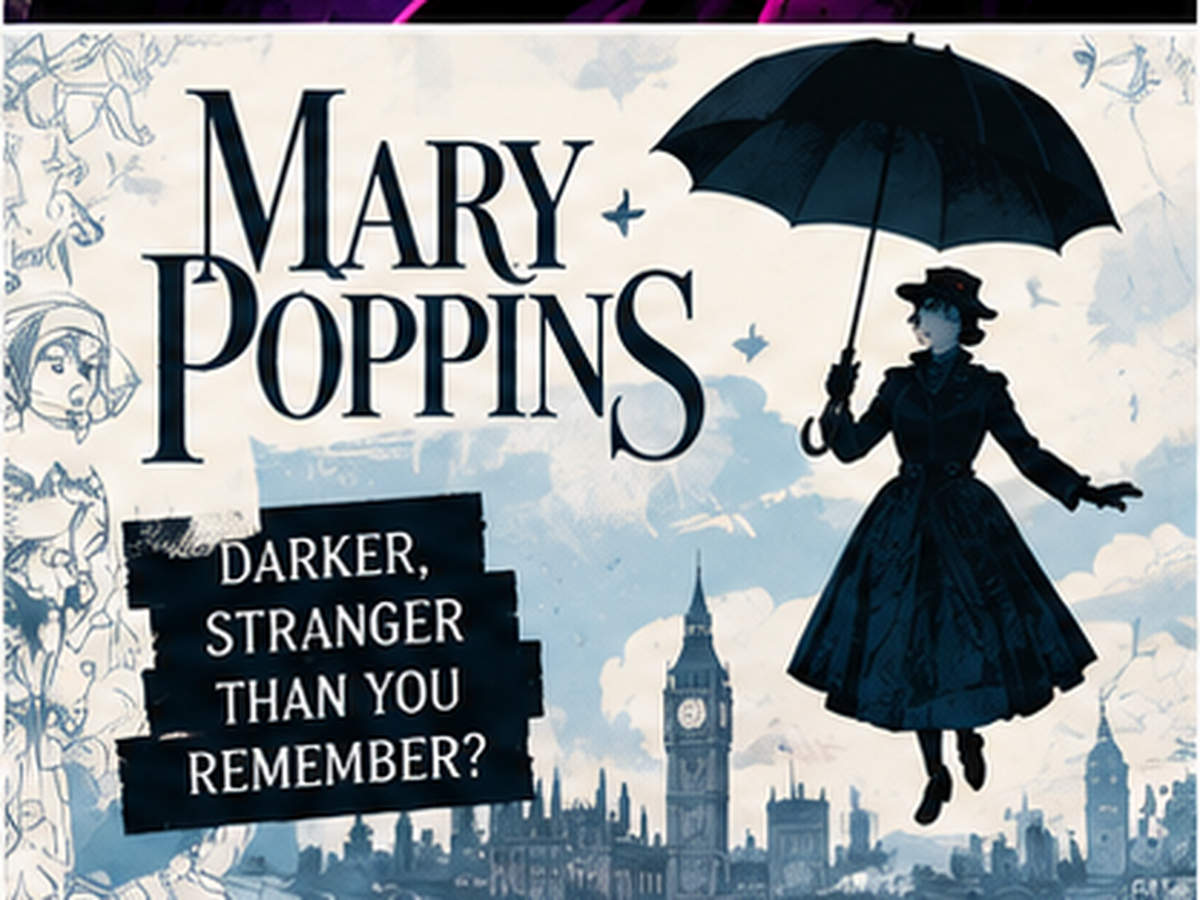
A new Mary Poppins series is going back to the books and they are much stranger than the Disney film
For generations of viewers, Mary Poppins means Julie Andrews descending from the clouds with an umbrella, dancing chimney sweeps and the reassurance that a spoonful of sugar will make almost anything manageable. L. Travers’ Mary Poppins is a rather different woman.
That distinction has suddenly become important again because a new live-action Mary Poppins television series is in early development — and instead of adapting Disney’s 1964 movie, the project intends to return to Travers’ original books.
If it moves forward, audiences may discover that Cherry Tree Lane was always considerably stranger than they remembered.
What has actually been announced?
Producer Tom Winchester is developing the project through Pure Fiction Television after optioning rights from the trustees of the P. L. Travers estate. The plan is to draw from Travers’ eight Mary Poppins books rather than remake the Disney film. This is still very early.
There is currently:
- no broadcaster or streaming service attached,
- no announced cast,
- no confirmed showrunner,
- and no production date.
Winchester is reportedly speaking with potential showrunners. There have also been early conversations with Disney, but Disney is not currently confirmed as a partner. That distinction matters because several headlines have already made the project sound like a Disney+ series. That has not been officially established.
So how different is book Mary?
Very. Julie Andrews’ Mary is firm but reassuring, elegant and fundamentally warm. Travers’ version is sharper, vain, impatient and often deliberately mysterious. The children frequently experience something impossible with her only for Mary to flatly refuse to acknowledge that anything unusual has happened. Older examinations of the books have described her as short-tempered, snobbish and considerably less sentimental than her cinematic counterpart. Her magical world is stranger too.
The books move through episodes involving talking animals, constellations, mythological figures, impossible relatives and transformations that can feel closer to a dream or folktale than a traditional family fantasy.
Bad Wednesday is particularly unsettling
One of the clearest examples comes from the story “Bad Wednesday”. Jane Banks is drawn into the painted world of a decorative bowl. What initially looks like another magical adventure becomes much more threatening when an old man inside the scene informs Jane that she now belongs there and will have to remain inside the bowl. Mary eventually intervenes. But the imagery is much closer to a dark fairy tale than the cheerful image many people associate with Mary Poppins. Disney later borrowed elements of the sequence for Mary Poppins Returns, but Travers’ original story remains stranger and more uncomfortable.
Then there is the mythology
Travers did not simply write a series of whimsical nanny adventures. Her books repeatedly connect Mary to a much larger natural and mythological world. One famous sequence takes Jane and Michael to the zoo at night, where the relationship between humans and animals is reversed and a great snake speaks about the connectedness of all living things. Mary is not presented merely as a woman who happens to know magic. There is often a suggestion that she belongs to something older and larger than the ordinary world around the Banks family.
Disney didn’t invent everything
None of this means the 1964 film has nothing to do with Travers. Several famous sequences originated in the books, and Disney’s adaptation retained more of their structure than the enormous tonal differences might suggest. But Walt Disney reshaped Mary into a warmer character and built a clearer emotional arc around Mr Banks and his relationship with his children. Travers famously disliked many of those changes. The result is that two different versions of Mary Poppins have existed in popular culture for decades.
What happens next?
This is the point where patience is required. The television series is in development, not in production. The next meaningful announcements would be a broadcaster or streamer, a showrunner, writers and eventually casting. Until then, there is no reason to start imagining who should play Mary. The genuinely interesting part already exists. A production team has gone back to P. L. Travers’ books. And if they really intend to follow them, audiences who think they know Mary Poppins may be in for a surprise.
Share this article
