
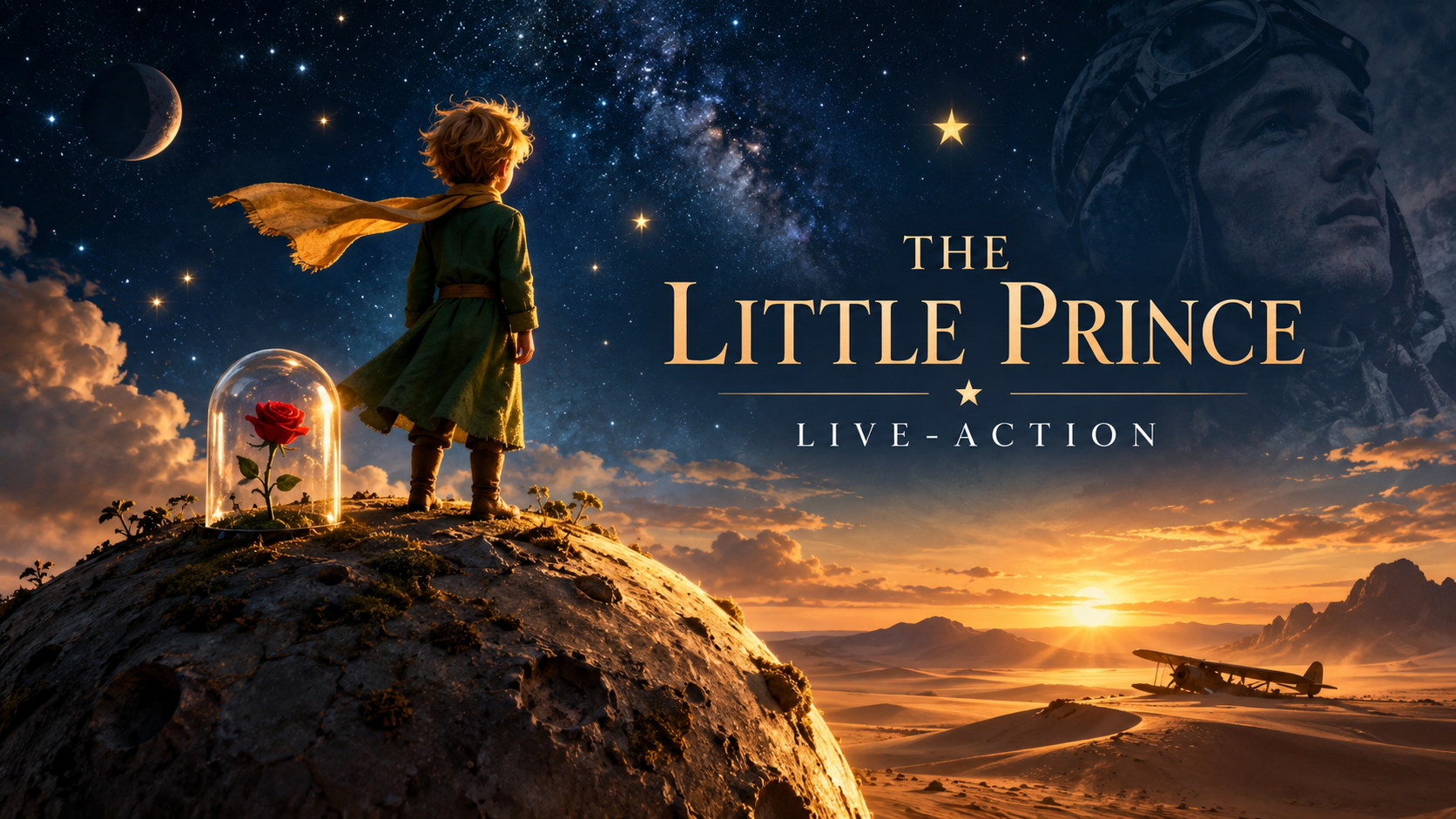
The Little Prince Is Getting a Live-Action Movie But This Is Much More Than Another Remake
There are some books that seem almost impossible to adapt because so much of their magic exists somewhere between the words, the illustrations and whatever the reader brings to them.
Antoine de Saint-Exupéry’s The Little Prince is one of those books.
It has already been a live-action musical, a Soviet film, an anime, an opera, several animated television series, a major animated movie, a graphic novel, a Broadway spectacle and countless stage productions.
And now it is heading back to the cinema again.
A new live-action The Little Prince feature film is officially in development, with The Imitation Game director Morten Tyldum attached to direct and Oscar-winning Slumdog Millionaire screenwriter Simon Beaufoy writing the screenplay.
But calling this simply a “live-action remake” does not really explain what the filmmakers are attempting.
This version will apparently bring together two stories that have always been inseparable: the Little Prince and the extraordinary man who created him.
This Little Prince movie will also tell Antoine de Saint-Exupéry’s story
The film is being developed with Le Petit Prince Groupe, which safeguards Saint-Exupéry’s legacy, and is produced by Aton Soumache and Paul Trijbits through Magical Society.
Soumache is an especially interesting name here because he also produced Mark Osborne’s beautiful 2015 animated The Little Prince.
The new film will reportedly combine Saint-Exupéry’s real life as an aviator and writer with the fantasy of the book. The biographical material will be filmed in live action, while the Little Prince and his world will be realised using visual effects.
It will also draw elements from French artist and filmmaker Joann Sfar’s acclaimed graphic-novel adaptation, particularly the relationship between the Aviator and the Little Prince.
That immediately makes this something different from simply filming the novella scene by scene.
It potentially turns the Aviator into something much closer to Saint-Exupéry himself.
And considering Saint-Exupéry’s life, there is plenty of story there.
The man behind the Little Prince almost sounds like one of his own characters
Antoine de Saint-Exupéry was not merely an author who happened to like aeroplanes.
He was an actual pioneering aviator.
He earned his pilot’s licence during military service, flew routes for the company that became Aéropostale and helped develop early air-mail routes across North Africa and South America. His experiences as a pilot fed directly into books including Southern Mail, Night Flight and Wind, Sand and Stars.
When France fell during the Second World War, Saint-Exupéry eventually went to the United States.
It was during this period that he wrote and illustrated The Little Prince.
The book was first published in New York in 1943, in French and English, before its post-war publication in France in 1946.
Then the author’s own story acquired an ending almost as mysterious as anything in his fiction.
Saint-Exupéry returned to military flying and joined reconnaissance operations.
On 31 July 1944, he took off from Corsica in a Lockheed P-38 on a photographic reconnaissance mission.
He never returned.
His aircraft was eventually identified decades later off the coast near Marseille, but the precise circumstances of the crash remain unresolved.
There is therefore something particularly poignant about a new adaptation connecting the Little Prince’s journey through the stars with the life of the aviator who created him.
So what exactly do we know about the new movie?
At this stage, quite a lot about the creative approach but very little about the practical details.
Morten Tyldum is directing. His films include The Imitation Game, Headhunters and Passengers.
Simon Beaufoy is writing. Beaufoy won the Academy Award for Slumdog Millionaire and also wrote films including The Full Monty and The Hunger Games: Catching Fire.
Aton Soumache and Paul Trijbits are producing.
The Saint-Exupéry estate is directly involved.
The project is intended as a large-scale family adventure.
What has not been announced yet is equally important.
There is currently no confirmed cast, production start date or theatrical release date.
So any claims about who will play Saint-Exupéry, the Aviator or the Little Prince are currently speculation.
But this certainly isn’t the first Little Prince movie
Far from it.
One reason the new adaptation is so fascinating is that filmmakers have been trying to solve the same problem for around 60 years:
How do you turn such a small, philosophical, strangely melancholy illustrated book into something cinematic?
Almost every generation has come up with a different answer.
1966: The Little Prince reaches film for the first time
The earliest feature adaptation came not from Hollywood or France but from the Soviet Union.
Lithuanian filmmaker Arūnas Žebriūnas directed Mažasis princas in 1966, starring Evaldas Mikaliūnas, Donatas Banionis and Otar Koberidze.
The 68-minute film was the first feature-length screen adaptation of Saint-Exupéry’s story.
That same year another unusual version was being created in East Germany.
Director Konrad Wolf made Der kleine Prinz for East German television. Filmed in highly stylised artificial landscapes, the 77-minute adaptation was completed in 1966 but did not actually premiere on television until 1972, with rights problems helping push it back into the archives afterwards.
So even before Hollywood reached the story, there were already two very different European interpretations of B-612.
1974: Gene Wilder, Bob Fosse and a very strange Hollywood musical
For many older fans, the first screen version they remember is Stanley Donen’s 1974 musical The Little Prince.
And its cast is remarkable.
Steven Warner played the Little Prince.
Richard Kiley was the Pilot.
Gene Wilder played the Fox.
And legendary dancer and choreographer Bob Fosse played the Snake, complete with one of the most unmistakably Fosse dance performances ever committed to a family film.
The screenplay and lyrics were written by Alan Jay Lerner with music by Frederick Loewe, the team responsible for My Fair Lady.
It is a genuinely unusual movie.
Rather than trying to make Saint-Exupéry’s tiny planets realistic, Donen embraced theatrical sets, musical numbers and dreamlike staging.
It did not become a major box-office hit, but it developed a cult reputation, particularly because of Wilder and Fosse.
And if you have never watched Bob Fosse perform “Snake in the Grass”, it may permanently alter the way you imagine the snake in the book.
1978: The Little Prince becomes an anime
Long before anime adaptations of Western stories became commonplace internationally, Japan created The Adventures of the Little Prince.
The television anime began in 1978 and produced 39 episodes.
Rather than repeatedly retelling the short book, the series expanded the Prince’s travels and gave him new adventures and encounters.
Only part of the series initially reached English-speaking audiences, but the programme later developed a considerable nostalgia following of its own.
For a generation of viewers, this was not an adaptation they discovered after reading Saint-Exupéry.
It was their introduction to the Little Prince.
1974 also gave us Richard Burton’s famous audio version
Not every important adaptation has been visual.
In March 1974, Richard Burton recorded an abridged dramatic version of The Little Prince with a cast that included Jonathan Winters, John Carradine and Jim Backus.
The production won a Grammy for Best Children’s Recording and became one of the better-known English-language audio interpretations of the story.
That format arguably suits the book remarkably well.
The original novel already feels like somebody sitting beside you and quietly telling you something that happened a very long time ago.
2003: The Little Prince becomes an opera
Then someone asked the obvious question:
What if the Little Prince sang opera?
Composer Rachel Portman and playwright Nicholas Wright created a two-act children’s opera based on Saint-Exupéry’s story.
It premiered at Houston Grand Opera on 31 May 2003.
The BBC later created a filmed UK production following a nationwide search for child performers. More than 25,000 children reportedly applied, with the resulting production broadcast on BBC Two in 2004.
The opera has continued to be staged internationally more than two decades later.
2008: Joann Sfar redraws an untouchable classic
French cartoonist Joann Sfar took on an intimidating challenge in 2008: reimagining a book whose original illustrations are almost as famous as its words.
His Little Prince graphic novel retold Saint-Exupéry’s story using Sfar’s own energetic, expressive visual language.
The adaptation was officially authorised and became one of the best-known reinterpretations of the book.
It is particularly relevant now because material from Sfar’s version is reportedly feeding into the new live-action movie.
There is also an interesting piece of development history here.
Back in 2019, Sfar and Aton Soumache were already developing a much larger live-action/CGI Little Prince project conceived as five fantasy mini-movies.
That project did not emerge in that form, but the creative relationship has clearly not disappeared.
2010: The Little Prince gets a whole universe
The 2010 French animated television series took an even bigger step away from a straightforward adaptation.
Instead of simply recreating the novella, the series sent the Little Prince and the Fox travelling from planet to planet, trying to repair worlds affected by the Snake.
The series eventually ran for 78 episodes across three seasons.
This version effectively transformed Saint-Exupéry’s philosophical traveller into the hero of an ongoing children’s fantasy universe.
Purists may prefer the original’s quiet simplicity, but it demonstrated something important:
The Little Prince could become a recurring character rather than merely the protagonist of one short story.
2015: The adaptation that found a completely different way into the book
For many modern viewers, Mark Osborne’s 2015 animated film remains the defining screen adaptation.
And its smartest decision was not trying to make the original book fill an entire conventional movie.
Instead, Osborne created a new framing story.
A highly organised young girl moves next door to an eccentric elderly Aviator.
He begins telling her about a strange child he once met in the Sahara.
His memories of the Little Prince are depicted in delicate stop-motion animation, while the girl’s modern world uses computer animation.
The English-language voice cast included:
Jeff Bridges as the Aviator, Mackenzie Foy as the Little Girl, Rachel McAdams as her mother, Marion Cotillard as the Rose, James Franco as the Fox, Benicio del Toro as the Snake, Ricky Gervais as the Conceited Man and Riley Osborne as the Little Prince.
Hans Zimmer and Richard Harvey composed the score.
The film premiered at Cannes in 2015 and later won the César for Best Animated Film as well as a BAFTA Children’s Award. The 2015 movie understood something very important about the book. It is not merely a story about childhood.
It is a story about remembering childhood after becoming an adult.
2022: The Little Prince flies over Broadway
The Little Prince’s next major transformation involved considerably fewer spaceships and considerably more aerial acrobatics.
A stage production directed and choreographed by Anne Tournié, with an adaptation by Chris Mouron and music by Terry Truck, combined theatre, dance, video projections and aerial performance.
After international productions, it opened at Broadway Theatre in New York in April 2022.
Lionel Zalachas played the Little Prince, Aurélien Bednarek the Aviator and Chris Mouron the Narrator.
The Broadway run was brief, but the production continued internationally.
Again, the story had found an entirely different language.
Not film.
Not animation.
Movement.
2023: The Little Prince and Friends brings him to preschoolers
The franchise changed direction again for The Little Prince and Friends, a 2D animated preschool series.
The show features children Elijah and Charlotte travelling with the Little Prince, Fox and Rose aboard a transformed Asteroid B612.
The series consists of 52 eleven-minute episodes, with stories designed around confidence, friendship and other values drawn from Saint-Exupéry’s original work.
This is obviously far removed from the melancholy philosophical tone of the novella.
But perhaps that adaptability is part of the character’s strange durability.
Children can meet him one way.
Adults can meet him another.
2026: MinaLima reimagines the actual book
This year also brought another striking interpretation.
Design studio MinaLima, famous for its elaborate graphic work and interactive illustrated books, created a new anniversary edition in which Saint-Exupéry’s complete text was entirely reillustrated and given interactive paper-engineered elements.
The worldwide edition was released on 2 April 2026 to mark 80 years since the book’s French publication.
That makes the timing of this new movie especially appropriate.
The Little Prince is not sitting quietly on a classics shelf.
It is going through another period of intense reinvention.
And there is another Little Prince movie being made in China
Interestingly, the Morten Tyldum film is not the only new Little Prince movie currently in development.
A separate Chinese animated feature from Shanghai’s El Pajaro Pictures and Stars Collective was announced for 2026.
Translator Li Jihong is directing the project.
The film uses a hybrid animation technique combining 2D watercolour with a 3D oil-painting aesthetic and also combines the Little Prince’s world with Saint-Exupéry’s life between 1940 and 1944.
The project has official approval from the organisation representing the Saint-Exupéry estate.
No firm international release information has yet been announced.
It is fascinating that two completely separate modern films have arrived at a similar idea:
perhaps the next way to understand The Little Prince is to understand the man who was flying behind him.
Why does everyone keep returning to The Little Prince?
That may be the most interesting question of all.
The book is tiny. Its plot is simple.
A pilot crashes in the Sahara. He meets a boy from a tiny asteroid. The boy tells him about his Rose and the peculiar adults he encountered while travelling between planets. He meets a Fox. He learns something about friendship. And eventually he leaves.
Yet underneath that children’s story are loneliness, grief, adulthood, love, responsibility, mortality and the question of what actually makes a life meaningful.
That is why the King, Businessman, Drunkard and Conceited Man are funny when you are young and increasingly uncomfortable when you meet them again as an adult.
It is why the Rose can seem annoying during one reading and heartbreaking during another.
It is why the Fox’s lesson about creating bonds stays with people.
And it explains why filmmakers have never quite been able to leave the book alone.
The new movie has one enormous advantage
Trying to make the “definitive” live-action Little Prince would be an almost impossible assignment.
Fortunately, the new filmmakers do not appear to be trying.
Instead, Morten Tyldum and Simon Beaufoy are exploring Saint-Exupéry and his creation together.
That could allow the film to ask something more interesting than simply, “How do we make Asteroid B612 look realistic?”
Why did an aviator who had crossed continents, survived crashes, witnessed war and experienced extraordinary isolation write this particular little book?
Why a boy? Why a rose? Why a pilot stranded in a desert? Why do the adults behave so strangely? And why, more than 80 years later, do readers still recognise themselves in it?
Those are questions worth building a movie around.
There is no casting or release date yet, so there is still a great deal we do not know.
But after Soviet cinema, Gene Wilder, Bob Fosse, Japanese anime, opera, CGI, stop motion, Broadway acrobatics and several generations of animation, the Little Prince is preparing to leave B-612 once again.
And somehow, he still has somewhere new to go.
Share this article
