
The Shape of Water: 20 interesting facts about Guillermo del Toro’s Spellbinding World
Guillermo del Toro’s The Shape of Water is a 2017 romantic fantasy film that blends science fiction, horror, fairy-tale imagery and Cold War paranoia into one of the director’s most visually striking movies.
The film was both a critical and commercial success, earning widespread praise for its imaginative storytelling, production design, cinematography, music and performances. Guillermo del Toro’s direction was particularly celebrated, while Sally Hawkins delivered an acclaimed performance as Elisa Esposito, a non-speaking woman who develops a profound connection with an amphibious creature held captive in a secret government facility.
The film’s impressive supporting cast includes Octavia Spencer, Richard Jenkins, Michael Shannon and Michael Stuhlbarg, with each character playing an important role in Elisa’s extraordinary journey.
At the 90th Academy Awards, The Shape of Water received 13 nominations, making it the most-nominated film of the ceremony. It won four Oscars, including Best Picture, Best Director for Guillermo del Toro, Best Original Score for Alexandre Desplat and Best Production Design. It was also nominated for Sally Hawkins’ performance, Richard Jenkins’ supporting performance, and its original screenplay, among other categories.

Synopsis (contains spoilers)
The Shape of Water is set in 1962, during the height of the Cold War. The story takes place primarily in a secretive government research facility in Baltimore, Maryland, where Elisa Esposito works as a cleaner.
Elisa is a non-speaking woman who communicates primarily through American Sign Language. Her life is quiet and repetitive, and she lives alone in an apartment above a cinema. Her closest friend is Giles, a lonely artist who struggles with his own personal identity and place in the world.
Everything changes when a mysterious amphibious humanoid is brought into the facility. The creature, played by Doug Jones, is being studied and tortured by the government because of his extraordinary abilities.
Elisa becomes fascinated by him and gradually develops a bond with the creature. Although they cannot communicate through spoken language, they find other ways to understand one another through gestures, music and shared experiences.
Their relationship eventually becomes romantic, and Elisa decides that she cannot stand by while the creature is tortured and killed. With the help of Giles, her co-worker Zelda Fuller and scientist Robert Hoffstetler, Elisa attempts to rescue him from the laboratory.
However, the creature’s escape sets off a dangerous chain of events. Colonel Richard Strickland, the ruthless government official overseeing the creature’s captivity, becomes determined to find him and bring him back.
As the story unfolds, it becomes clear that Hoffstetler is actually a Soviet spy named Dimitri, adding another layer to the Cold War tensions surrounding the story.
The film reaches its emotional climax when Strickland discovers where Elisa has taken the creature. In the final confrontation, Strickland shoots both Elisa and the creature.
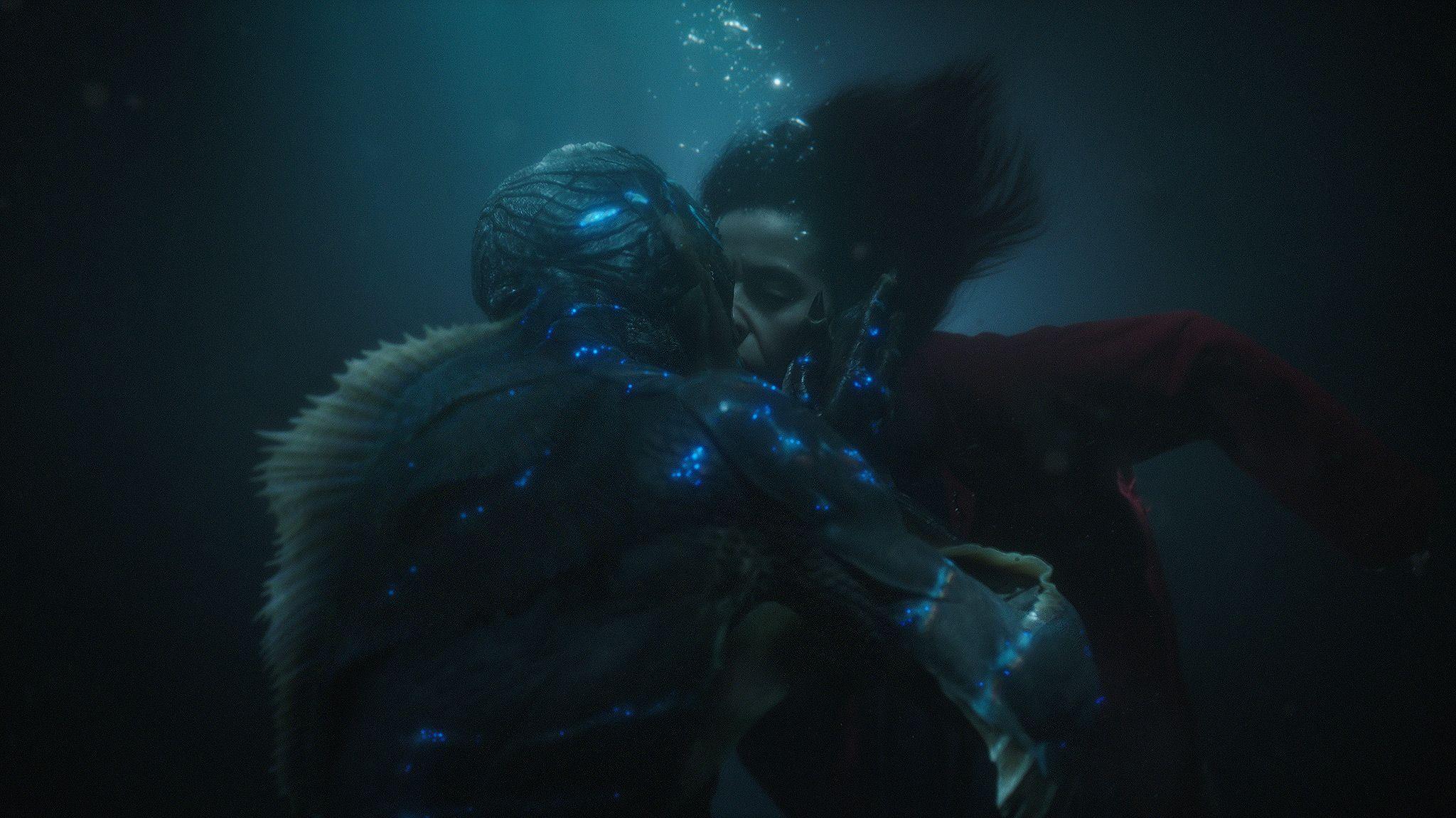
The creature, however, possesses extraordinary healing abilities. He revives Elisa and carries her into the water. The final scene reveals the scars on Elisa’s neck opening into gills, suggesting that she has become amphibious herself.
The film ends with Elisa and the creature together beneath the water, leaving viewers with a beautiful and deliberately fairy-tale-like conclusion.
Rather than being a simple story about a woman falling in love with a monster, The Shape of Water is ultimately about two outsiders finding acceptance and belonging in one another.
More about the film
The Shape of Water is the kind of film that stays with you long after the credits roll. Its combination of romance, fantasy, horror and Cold War thriller elements gives it a distinctive atmosphere that is unmistakably Guillermo del Toro.
At its heart, the movie is a love story about outsiders. Elisa is marginalised because she cannot speak, while the creature is treated as an object rather than a living being. Giles and Zelda also experience prejudice and discrimination, making the film’s central theme of “the other” extend beyond the creature itself.
The film also explores loneliness, intolerance, identity and the human desire for connection. Strickland represents a world obsessed with control, conformity and power, while Elisa and the creature represent empathy and the possibility of loving someone who does not fit society’s expectations.
Visually, the film is filled with water imagery and shades of blue and green. Water becomes a recurring symbol throughout the story, representing transformation, freedom and love.
Sally Hawkins’ performance is particularly important because Elisa has no spoken dialogue. Her emotions are communicated through facial expressions, body language and sign language, allowing the performance to become intensely physical and expressive.
The supporting cast is equally impressive. Octavia Spencer plays Elisa’s outspoken and loyal friend Zelda Fuller, Richard Jenkins portrays Giles, Michael Shannon plays the terrifying Colonel Strickland, and Michael Stuhlbarg appears as the conflicted scientist Dr. Robert Hoffstetler.
The result is a visually gorgeous and emotionally unusual fairy tale that asks a simple but powerful question: Who gets to decide what makes someone a monster?
Not in the mood to read? Watch the video here.
Looking for a unique gift? Visit our Red Bubble store.
20 Fun facts about The Shape of Water (contains spoilers)
1. The film was inspired by The Creature from the Black Lagoon
Guillermo del Toro has spoken about his childhood love of Creature from the Black Lagoon (1954) and his fascination with the idea of the Gill-man and Kay Lawrence falling in love.
That idea became one of the starting points for The Shape of Water. However, del Toro did not simply remake the classic monster movie. Instead, he imagined what would happen if the “monster” and the human woman actually became the heroes of their own love story.
2. Doug Jones spent hours in the Amphibian Man costume
Doug Jones, a frequent Guillermo del Toro collaborator, played the Amphibian Man. The elaborate costume and makeup required considerable preparation, with the actor spending hours being transformed into the creature.
The physical performance was especially demanding because Jones had to communicate the creature’s emotions almost entirely through movement, posture and facial expression.
3. The film is deliberately set in 1962
Although the story deals with issues that remain relevant today, del Toro chose to set the movie in 1962.
The period setting allows the film to operate like a fairy tale while also exploring the tensions of the Cold War and the prejudices of the era.
The year is also significant because the story takes place during a period of intense conflict between the United States and the Soviet Union.
4. The film’s original screenplay was written by Guillermo del Toro and Vanessa Taylor
Del Toro developed the story and co-wrote the screenplay with Vanessa Taylor.
The Academy officially credited the film’s screenplay as Written by Guillermo del Toro and Vanessa Taylor; Story by Guillermo del Toro.
5. The creature was nicknamed “Charlie”
During production, the Amphibian Man was reportedly referred to as “Charlie” by members of the production team.
The nickname helped distinguish the character behind the scenes from the various technical and descriptive terms used to refer to him during production.
6. Baltimore was recreated in Toronto
Although the story takes place in Baltimore, much of the film was shot in and around Toronto, Ontario.
The production used Canadian locations and carefully designed sets to recreate the film’s 1960s American setting.
7. Sally Hawkins prepared for Elisa without relying on dialogue
Because Elisa does not speak, Sally Hawkins had to communicate the character’s thoughts and emotions through movement, expressions and sign language.
Del Toro encouraged Hawkins to study performers from the silent-film era, including Charlie Chaplin, Buster Keaton and Stan Laurel.
Her performance ultimately earned her an Academy Award nomination for Best Actress.
8. The film received 13 Oscar nominations
The Shape of Water received 13 Academy Award nominations, making it the most-nominated film at the 90th Academy Awards.
It ultimately won four Oscars:
-
Best Picture
-
Best Director – Guillermo del Toro
-
Best Original Score – Alexandre Desplat
-
Best Production Design
The film was also nominated for Sally Hawkins’ performance, Richard Jenkins’ supporting performance, cinematography, costume design, film editing, sound editing, sound mixing and original screenplay.
9. Guillermo del Toro created detailed histories for his characters
One of del Toro’s trademarks is developing extensive backstories for his characters, even when much of that information never appears directly in the film.
This helped create the feeling that the characters had full lives and histories beyond what audiences see on screen.
10. The Amphibian Man’s vocalisation includes Guillermo del Toro’s breathing
The creature’s sounds were carefully designed to make him feel both human and otherworldly.
One of the more unusual details associated with the character is that Guillermo del Toro’s own breathing was incorporated into the creature’s vocal performance.
11. Elisa’s surname has an interesting meaning
Elisa’s surname is Esposito, an Italian name historically associated with children who were abandoned or left at foundling institutions.
The detail adds another layer to Elisa’s character and her sense of being someone who has never fully belonged.
However, the film deliberately leaves much of Elisa’s childhood mysterious, so the name should be viewed as symbolic rather than definitive proof of her personal history.
12. The dance sequence pays tribute to classic Hollywood musicals
The film contains a striking fantasy sequence in which Elisa and the Amphibian Man dance together.
The sequence reflects del Toro’s love of classic cinema and musicals and has been linked to the visual language of classic Hollywood dance films, including Fred Astaire and Ginger Rogers movies.
Rather than being a random musical detour, the sequence shows how Elisa imagines romance and how cinema influences the fairy-tale world of the film.
13. Sally Hawkins was Guillermo del Toro’s first choice for Elisa
Del Toro has spoken extensively about writing the role specifically with Sally Hawkins in mind.
Her ability to communicate emotion without dialogue was central to the character, and Hawkins’ performance became one of the most celebrated aspects of the film.
14. Del Toro won his first Oscar for Best Director
Guillermo del Toro won the Academy Award for Best Director for The Shape of Water.
The win was particularly significant because it marked the first time the Mexican filmmaker won the directing Oscar, following the success of his earlier films such as Pan’s Labyrinth and Hellboy.
15. The creature was designed to be beautiful as well as frightening
Del Toro did not want the Amphibian Man to look like a traditional horror monster.
The character was designed to be physically powerful but also graceful and attractive. The filmmakers wanted audiences to understand why Elisa would be drawn to him.
Doug Jones’ performance was crucial in giving the creature a sense of vulnerability and personality beneath the elaborate makeup and costume.
16. The film premiered at the Toronto International Film Festival
The Shape of Water premiered at the 2017 Toronto International Film Festival, where it quickly became one of the major films of the festival.
Its Toronto premiere was particularly fitting given how much of the production had taken place in Canada.
17. Doug Jones had already played a famous amphibious character for del Toro
Doug Jones and Guillermo del Toro had worked together before.
Jones famously played Abe Sapien, the amphibious humanoid character in Hellboy and Hellboy II: The Golden Army.
The Amphibian Man in The Shape of Water has some visual similarities to Abe Sapien, but the two characters are entirely separate.
18. Green is one of the film’s dominant colours
Green appears repeatedly throughout the movie, from costumes and props to food, cars and set decoration.
The colour helps establish the film’s distinctive visual identity and connects the world of the laboratory to the mysterious aquatic creature.
The film’s use of green and blue also reinforces its recurring water imagery.
19. The theatrical poster was created by artist James Jean
The film’s memorable theatrical poster was illustrated by artist James Jean.
The artwork captures the movie’s central romantic imagery, presenting Elisa and the Amphibian Man in a dreamlike underwater embrace.
The poster fits perfectly with the film’s fairy-tale aesthetic and became one of the most recognisable pieces of artwork associated with the movie.
20. Elisa’s story echoes classic tales of transformation
One of the most interesting ways to interpret The Shape of Water is as a story of transformation.
The film contains echoes of classic stories such as Pygmalion and Frankenstein, while also reversing the traditional “beauty and the beast” formula.
Instead of a beautiful woman transforming a monster into a human, The Shape of Water suggests that love allows two outsiders to transform together.
The ending takes this idea even further. When the Amphibian Man brings Elisa into the water, her scars open into gills, suggesting that she was always connected to the aquatic world in some way—or that love itself has transformed her.
This ambiguity is part of what makes the ending so memorable.
The Shape of Water remains one of Guillermo del Toro’s most fascinating films because it refuses to fit neatly into a single genre.
It is a romance, a monster movie, a fairy tale, a Cold War thriller and a story about outsiders finding one another. Its visual style, haunting score and remarkable performances all work together to create something that feels both familiar and completely unique.
At its centre is a simple idea: perhaps the real monsters are not the creatures who look different from us, but the people who refuse to see their humanity.
And that may be the real magic of The Shape of Water.
Share this article
