

Unmasking the Origins: The Pre-Opera Life of Erik, the Phantom of the Opera
Erik, the enigmatic figure haunting the Paris Opera House, is a character shrouded in mystery and tragedy. While Gaston Leroux’s 1910 novel The Phantom of the Opera introduces readers to Erik’s haunting presence beneath the opera house, it offers only glimpses into his past. Subsequent adaptations and literary works have sought to fill these gaps, painting a multifaceted portrait of a man marked by genius, deformity, and profound isolation.
Early Life: Born into Rejection
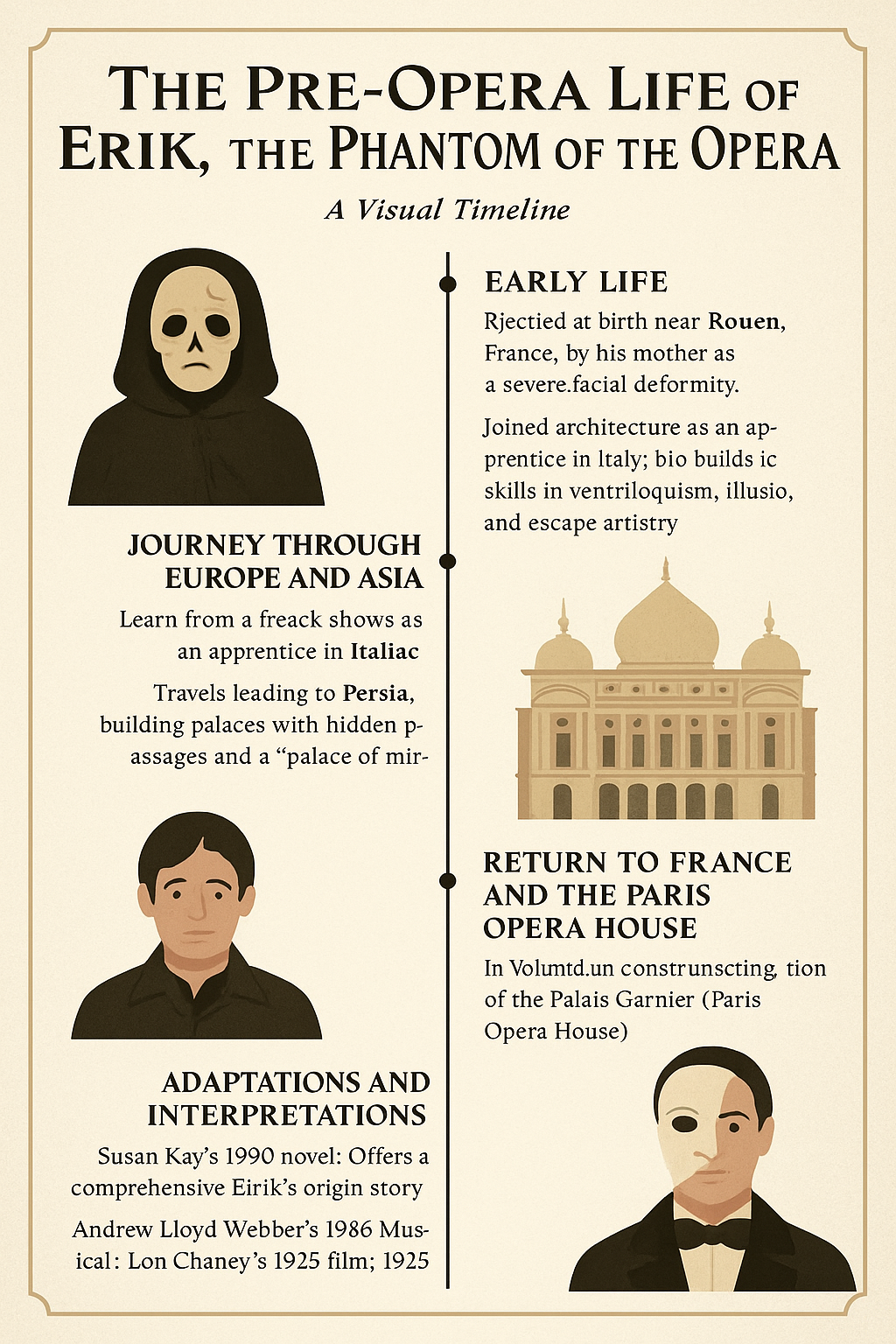
In Leroux’s narrative, Erik is born in a small town near Rouen, France, with a congenital facial deformity so severe that his mother is horrified by his appearance. She rejects him, leading Erik to flee at a young age. He becomes part of traveling fairs, where he’s exhibited as “le mort vivant” or “the living corpse,” honing skills in ventriloquism, illusion, and escape artistry during this time.
Susan Kay’s 1990 novel Phantom expands upon this backstory, naming Erik’s birthplace as St. Martin de Boscherville in 1831. His mother, Madeleine, is portrayed as a vain woman who cannot bear to look at her son, further deepening his sense of abandonment.
A Journey Through Europe and Asia
Erik’s escape from the freak shows leads him across Europe and Asia. In Italy, he apprentices under a master mason named Giovanni, learning architecture and construction. His travels eventually take him to Persia, where his talents catch the attention of the Shah. Erik is commissioned to build elaborate palaces equipped with hidden passageways and a notorious “palace of mirrors,” a torture chamber designed to disorient and drive prisoners to madness.
During his time in Persia, Erik befriends the Daroga, the chief of police, who later plays a crucial role in his life. When Erik falls out of favor with the Shah and faces execution, the Daroga helps him escape, faking Erik’s death by presenting another body in his place.
Return to France and the Paris Opera House
Upon returning to France, Erik becomes involved in the construction of the Palais Garnier, the Paris Opera House. Utilizing his architectural expertise, he secretly builds a lair for himself within the opera’s foundations, complete with hidden passages and a subterranean lake. From this hidden abode, Erik exerts control over the opera house, demanding a private box and a salary, and becoming the infamous “Opera Ghost.”
Adaptations and Interpretations
Erik’s origin story has been explored and reimagined in various adaptations:
-
Susan Kay’s Phantom (1990): Offers a comprehensive biography of Erik, delving into his childhood, travels, and emotional turmoil, providing a more humanized portrayal.
-
Andrew Lloyd Webber’s The Phantom of the Opera (1986): Focuses on the romantic and tragic aspects of Erik’s character, with less emphasis on his backstory.
-
1990 NBC Miniseries: Starring Charles Dance, this adaptation incorporates elements from both Leroux’s novel and Kay’s book, highlighting Erik’s relationship with his mother and his time in Persia.
-
Lon Chaney’s 1925 Film: Presents a portrayal closest to Leroux’s description, emphasizing Erik’s skeletal appearance and his role as a tragic villain.
Conclusion
The tapestry of Erik’s life before the opera house is woven from threads of rejection, genius, and a relentless quest for belonging. From his early days as a sideshow attraction to his architectural feats in Persia and Paris, Erik’s story is one of profound tragedy and complexity. Each adaptation adds depth to his character, reflecting society’s evolving understanding of monstrosity, isolation, and the human condition.
About the author : NerdiPop